BPC-157 Injection Guide
Everything you need to store, prepare, and self-administer your BPC-157 injections at home, with step-by-step guidance to help you feel confident from your very first dose.
Before you begin
This guide summarizes our official BPC-157 protocol to make getting started as simple as possible. This guide does not replace guidance from your provider–always follow your provider’s personalized instructions. BPC-157 should be refrigerated upon arrival, and when not in use. If you have concerns about the condition of your shipment upon arrival, read About your shipment before you start.
You’re making a great choice
Starting something new can come with questions. That’s completely normal. Here’s what researchers are studying BPC-157 for, and what we know so far.
Most of the research so far is preclinical, which means there’s still a lot we’re learning about BPC-157 in people. Your experience is your own, so focus on consistency and how you feel over the course of your journey.
Read first: safety
BPC-157 Injections are well tolerated by most people, but a few things mean you should pause and check in.
Stop and seek help if you experience:
- Shortness of breath, or swelling around the face, tongue, lips, or throat.
- Hives, a spreading rash, or difficulty breathing (signs of an allergic reaction).
- Feeling faint, or severe dizziness that doesn’t quickly settle.
If symptoms are severe, call emergency services (911). For milder but persistent concerns, contact your care team before your next dose.
This is normal
Redness, mild soreness, or a small bump where you injected is the most commonly reported side effect, and it usually settles within a day. A brief flush or warm feeling is also fairly common and nothing to be alarmed about. Rotating injection sites and holding a cold compress on the spot afterwards can help reduce irritation.
About your shipment
BPC-157 should be refrigerated upon arrival and in between uses, it should be kept away from direct light and heat, and never frozen.
Soft or melted ice packs are normal
Don’t be alarmed if the ice packs are soft or fully melted when you open your package. Your medication is shipped using packaging selected based on the formulation’s stability and transit studies. If your package arrives within the expected delivery window, the packaging has done its job, even if the ice packs have softened or melted. Refrigerate it as soon as it arrives.
If your order was delayed past the expected delivery window, arrived damaged or leaking, or the vial looks cloudy or frozen, keep the vial and message your care team before your next dose.
Storing it between doses
- Refrigerate at 36°F to 46°F, and keep the vial tightly closed when it is not in use.
- Avoid excessive heat, direct sunlight, and freezing temperatures.
- Skip humid rooms like a bathroom cabinet, but keep out of reach of children and pets.
- Check the beyond-use date (BUD) printed on your prescription label, and discard any product left after that date.
- Traveling is fine as long as the vial stays within recommended storage conditions. A small temperature-controlled case makes this much easier.
- If it arrives damaged or leaking, message your care team straight away before using it.
Discard 28 days after opening
Following CDC guidance for multi-dose vials, throw the vial away 28 days after you first puncture it, even if solution is left.
Also check the beyond-use date printed on your prescription label and discard the vial after that date, whichever comes first.
Dosing
There are two important things to keep in mind when it comes to dosing on BPC-157. The first is how much you inject for each dose, and the second is how long each dosing cycle runs. Always follow the specific dose your provider prescribed and the dose printed on your vial label. Your dosing instructions are also available 24/7 in your AgelessRx portal. You should never change your schedule without your prescriber’s approval–if you have questions, message your care team.
Reading your dose on the syringe
Your prescription label tells you exactly how much to draw up. Your BPC-157 is dispensed as a 5ml vial with a concentration of 3mg/ml. Your dose is 15 units once daily. Draw up to the 15 mark on your syringe, and always check that it matches the dose on your prescription label.
Please don’t go higher than your labeled dose
Take 15 units once daily, the amount printed on your prescription label. More isn’t better in this case. A larger dose empties the vial faster, and because BPC-157 studies have been limited, there are no proven benefits of increased dosing. If the dose you are prescribed doesn’t feel right, message your care team so your care plan can be reviewed and adjusted if necessary.
Missed a dose?
Take your next scheduled dose. Do not double up.
How long the cycle runs
BPC-157 is dosed in cycles. The standard course is one injection a day for 8 weeks, followed by a minimum of 4 weeks off (recommended 4-8 weeks), though your individual protocol may vary.
- 8 weeks on. One injection a day, every day, for the length your provider sets.
- Then a minimum of 4 weeks off (recommended 4-8 weeks). Nothing needs to be tapered. No weaning is necessary at the end of a cycle, you simply stop on the day your provider determines.
- Roughly the same time each day. Choose a time that already fits naturally into your routine. It’s one of the easiest ways to stay consistent.
If a dose feels uncomfortable
If you notice ongoing soreness at the injection site, mild stomach upset, or disturbed sleep, don’t skip ahead or change your daily dose. Continuing your normal dosing schedule and try rotating your injection sites to help resolve minor side effects. Sleep disturbances in particular are usually related to your dosage, so be sure to message your care team to determine the next best steps.
How long one vial lasts
You are dispensed a 5ml vial at 3mg/ml. How long it lasts depends on the dose on your prescription label.
If there is solution left in the vial when it’s time to discard it, that is normal. Message your care team if you’re concerned about running out before you reorder.
Ramp-up timeline
This is also when injection-site irritation may be most noticeable, so start rotating sites from your first dose.
Keep a simple log of your dose, injection site, and how you’re feeling. It makes subtle changes much easier to spot over time. Contact your care team before your next dose if something doesn’t feel right.
What you’ll need
Gather everything before you start, and set up on a clean, well-lit surface where you won’t be rushed. Wash your hands with warm, soapy water before handling anything. BPC-157 arrives as a ready-to-use solution, so there is nothing to mix or reconstitute.
- Your BPC-157 vial (5ml, 3mg/ml)
- A sterile syringe, one per dose
- Alcohol swabs
- A puncture-proof sharps container
- A clean, well-lit surface
Because this is a daily injection you will use one syringe a day. Your order ships with injection supplies. If you are running low before the cycle ends, message your care team and we can review your orders to ensure you receive the appropriate amount of syringes. Never re-use syringes.
Draw up your dose
Your syringe is marked in units. Your dose is 15 units. Your prescription label shows the same dose, so check it before you draw.
Give your injection
Where to inject
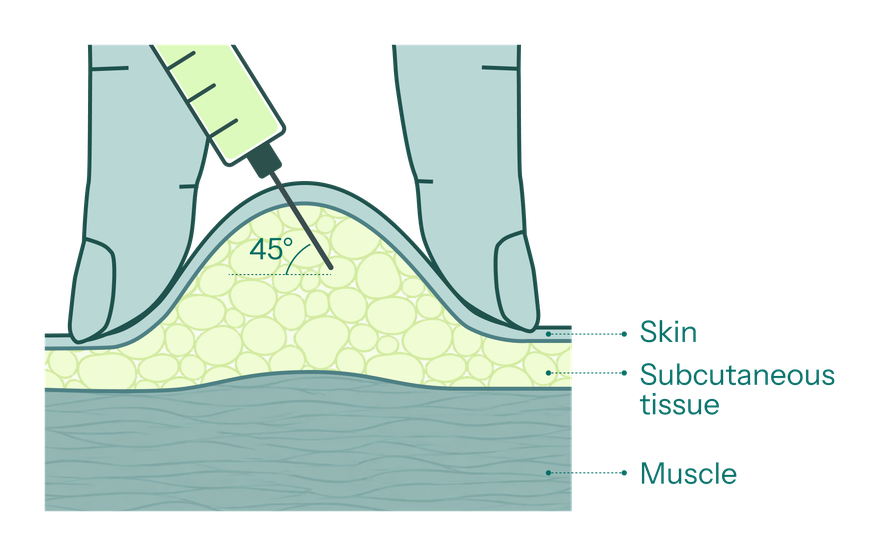
BPC-157 is given subcutaneously, which means into the fatty layer just under the skin rather than into muscle. The abdomen and the thigh are the usual sites, and anywhere with a comfortable fatty layer of skin will do.
- Abdomen. At least an inch away from the navel.
- Front or outer thigh.
- Back of the upper arm, if you can comfortably reach and pinch it.
A simple rotation habit
Because this is a daily injection, move to a fresh injection site every day. An easy way to remember: left abdomen, right abdomen, one thigh, then the other. Keep about an inch between sites and never inject into skin that is still sore, red, or bruised from an earlier dose.
Aftercare & disposal
- Dispose of sharps safely. Drop the used syringe straight into a puncture-proof sharps container. When it is about three-quarters full, seal it and follow your local guidance. Never put loose needles in household trash or recycling.
- Care for the site. A little redness or a small bump usually fades within a day. A cold compress held on the spot helps.
- Return the vial to the fridge promptly after each use, tightly closed.
- Log your dose. Note the date, the site you used, and how you felt. With a daily injection, a log is the only reliable way to keep your rotation honest and it makes any conversation with your provider much easier.
- Stay hydrated through the cycle. It’s one of the simplest ways to support yourself along the way.
Your dosing at a glance
The full BPC-157 protocol in one view. One fixed dose, once a day, for the length of the cycle your provider set. Your care team can adjust any of this to fit you.
Signals to adjust your dose
The goal isn’t to push through something that doesn’t feel right. Pay attention to how you’re feeling throughout your cycle, and keep us in the loop when something changes. Here’s what to watch for, and what to do about it.
Signs it’s going well
- Injection sites settle within a day, and you are not running short of fresh spots.
- No stomach upset, flushing, or disturbed sleep following a dose.
Signs to pause and check in
- Disturbed sleep. Usually related to the dose. Report it to us.
- Fatigue, mild stomach upset, or flushing that keeps coming back. Message your care team before your next dose.
- A site that stays red, hard, or painful for more than a couple of days. Stop using that area and check in.
- Any new lump or growth, or a flare of an existing one such as a keloid. Stop and contact your provider straight away.
Safety and interactions
Do not use BPC-157 if any apply
- Under 18 years of age
- Pregnant, or planning to become pregnant within the next 6 months
- Currently breastfeeding
- Significant heart dysfunction (ejection fraction under 50%, or NYHA Class III or greater)
- Active cancer, currently undergoing cancer treatment, or any cancer within the last 5 years
- A known hypersensitivity to BPC-157 or to peptide therapies
- Von Hippel-Lindau disease
- Diabetic Retinopathy
- A competitive athlete subject to WADA (World Anti-Doping Agency) testing
If you become pregnant during treatment, stop immediately and contact your OB.
Talk to your provider first if any apply
- Reduced kidney function or a lowered eGFR. Below 45, your provider will refer you before you start.
- Markedly elevated liver enzymes, more than 3 times the normal range.
- A proliferative condition such as endometriosis, BPH, or a tendency to form keloids.
- Regular use of two or more medications that are hard on the kidneys, such as long-term anti-inflammatory pain relievers or certain blood pressure medications.
Mention any recent surgery or planned procedure, any ongoing injury under medical evaluation, and any anti-inflammatory or recovery medication you take. BPC-157 is intended to sit alongside appropriate rehabilitation and care.
Drug interactions
BPC-157 has no well-established major drug interactions, but caution applies to three groups. Immunosuppressants could in theory alter the immune response, so your provider will want to monitor it. Sermorelin carries a theoretical risk of excessive growth signaling alongside BPC-157. Chemotherapy and immunotherapy drugs could interfere with treatment, and BPC-157 should be avoided while you are taking them. TB-500 and the Wolverine stack: BPC-157 monotherapy protocols can be used concurrently with TB-500 monotherapy protocols. Do not use concurrently with the Wolverine stack, as it contains both TB-500 and BPC-157. Tell your care team about every medication you take, including supplements and over-the-counter products.
Side effects
Most reported effects are local and mild. The most commonly reported effect is redness and pain at an injection site. Alternating sites and holding a cold compress on the spot afterwards is the recommended way to manage it, and effects are most likely in the first week or two of a cycle.
Common
- Redness at the injection site
- Pain or soreness at the injection site
- Headache
- Nausea
- Mild dizziness
Less common
- Fatigue
- Mild stomach upset
- Flushing or a warm sensation
- Sleep disturbance, usually related to the dose
Rare
- Abnormal tissue growth
- Acceleration of tumor growth
- Worsening of benign growths such as keloids
If an effect is mild, rotate your site and keep to the schedule. If symptoms worsen, become severe, or you notice any new or changing growth, stop and contact your provider. Seek immediate care for difficulty breathing or any sign of a severe allergic reaction.
Troubleshooting
It stung or burned when I injected
The vial looks emptier than I expected, or I think I’ll run out
I think I injected the wrong amount
Frequently asked questions
How long until I notice something?
What time of day should I inject?
Can I combine BPC-157 with other treatments or supplements?
What is BPC-157?
Who should not use BPC-157?
Can I travel with BPC-157?
Questions? We’re here
Your care team can help with dosing questions, side effects, storage worries, or anything that doesn’t feel right. Reach out any time before your next injection.
Log in to your patient portal to send a secure message, or call 650-503-9990.
Message your care team ›References and support
Injectables 101 ›- Frontiers in Aging, 2026. Review of the reported effects of BPC-157 on inflammation, tissue repair, and age-related damage.
- Current Reviews in Musculoskeletal Medicine, 2025. Narrative review of anti-inflammatory and regenerative effects in preclinical (animal) models, through angiogenesis and tissue-repair pathways.
- Cell and Tissue Research, 2019. Review of regenerative effects in preclinical models of tendon, ligament, and muscle injury.
- Journal of Applied Physiology, 2011. Preclinical study in rats reporting that BPC-157 promoted tendon healing through cell migration, cell survival under oxidative stress, and cell structure.
- American Journal of Gastroenterology, 2025. Review of gastrointestinal healing, including ulcers and inflammatory bowel disease, in preclinical models.
- Alternative Therapies in Health and Medicine, 2021. Small study in people reporting reduced knee pain, limited by sample size, the lack of a control group, and subjective outcome measures.
- For step-by-step injection instructions, visit agelessrx.com/injectables-101.
- Missed a dose? Take your next scheduled dose. Do not double up.
- Questions about your dose, your storage, or restarting after a break? Contact your care team before making changes.
- This guide is not a substitute for personal medical advice. Always consult your provider before changing your dose or routine.
The FDA has not reviewed these statements or approved this compounded product for any use, or for safety, efficacy, or quality. Prescription products require an online evaluation with a licensed provider who will determine if a prescription is appropriate. Risks and benefits outlined on agelessrx.com may be based on third-party studies. This guide is for general educational purposes and does not replace personalized medical advice. Always follow the instructions from your AgelessRx provider and the dosing on your prescription. If you experience a medical emergency, call 911.