Compounded Semaglutide Guide
A calm, step-by-step walkthrough for storing, measuring, and self-administering your weekly injection at home, including converting the milligrams on your label into units on your syringe.
Before you begin
This guide summarizes our official Compounded Semaglutide protocol. It does not replace your personalized guidance from your provider, and response varies from person to person.
Compounded Semaglutide is a compounded medication, prepared by a state-licensed compounding pharmacy. Your vials are shipped cold, so put them in the refrigerator as soon as they arrive. If the package arrives warm, frozen, or wet, check About your shipment for what to do next. If you’re still unsure, message your care team and we can help.
You’re making a great choice
It’s completely normal to feel a little uncertain before your first injection. Here is what semaglutide may help with.
Results vary from person to person, and the dose is raised gradually over several months. GLP-1 medications work best alongside a reduced-calorie meal plan and increased physical activity.
Read first: safety
Compounded Semaglutide is well tolerated by most people, but a few symptoms mean you should pause and check in.
Stop and seek help if you experience:
- Swelling of the face, lips, tongue, or throat, hives, or difficulty breathing, which are signs of an allergic reaction.
- Severe stomach pain that will not ease, with or without vomiting, especially pain that spreads through to your back.
- Vomiting or diarrhea you cannot stay ahead of, particularly with dizziness, very little urine, or dark urine, which point to dehydration.
If symptoms are severe, call emergency services (911). For milder but persistent concerns, contact your care team before your next dose.
This is normal
Nausea, bloating, belching, mild constipation, or looser stools are the most commonly reported effects, most likely in the first weeks and right after a step up. They normally settle on their own within a few days, or up to 2 to 3 weeks (see the full list under Side effects). Mild redness or a small bump at the injection site is also normal.
About your shipment
Your vials ship cold, in an insulated box with ice packs; refrigerate them after you open the box. In warmer months, ice packs may be melted upon arrival; as long as your order arrives within 48 hours, your medication is perfectly viable and safe.
Storing between doses
Keep your vials in the refrigerator between 36°F and 46°F, away from direct light and heat, and do not freeze them. If a vial has been kept below 36°F or above 46°F for an extended time, the solution may become ineffective.
Your ice packs melted. Is it still good?
Usually, melted ice packs are okay. What matters most is how the vial feels when you unpack it.
- Still cool or slightly cool: Put it in the refrigerator and use as usual.
- Room temperature: As long as your order arrives within the expected timeframe, and is refrigerated after opening it is safe to use. If you left your medication out at room temperature for an extended period of time, message your care team to let them know how long it may have been sitting out. Wait to inject until we’ve reviewed it with you.
- Hot to the touch: This is usually still safe to use, even at higher temperatures, as long as your order arrived within the expected timeframe. If you’re unsure, message your care team and we’ll help you confirm.
- Frozen or partly frozen: Don’t use it. Message your care team.
- Package is wet or soaked: Check the vial for cracks, leaks, or a loose cap. If the vial itself looks fine, use the temperature guidance above.
If you’re unsure, send us a message before injecting and we can help you decide what to do.
Discard 28 days after opening
Following CDC guidance for multi-dose vials, throw the vial away 28 days after you first puncture it, even if solution is left; write that date on the vial so you don’t lose track. Unpierced vials keep until the beyond-use date on the label.
Traveling with your medication
You can travel with your vials as long as the storage conditions above are still met on the road. Pack a small refrigerated or insulated case, and bring your own sharps container.
Dosing
There is one thing to keep in mind as you get started and your care team will help set it: how many units you inject. You’ll inject once a week, on the same day each week. The dose ramps up in steps over several months so your body has time to adjust and side effects stay mild.
Where your schedule comes from
You can find your injection schedule in two places: the label on your vial and your AgelessRx portal. Before every injection, read the dose in milligrams, the number of units to draw, and the strength of the solution.
Check your label before every dose
Concentrations can differ between pharmacies and between refills, so the units that were right last month may not be right now–always take a few seconds to check before you inject.
Missed a dose?
Take your dose within 5 days of the missed day, then resume a weekly schedule. If more than 5 days have passed, skip that dose and take the next one on schedule. Never double up.
Reading units on your syringe
Your syringe is marked in units, not milligrams or milliliters. Each unit is 0.01 mL: each small line is 1 unit, each large line is 10. Turning milligrams into units depends on the strength of your solution, so draw to the units your prescription label gives you.
| If your prescription says | That is | Where that sits on the barrel |
|---|---|---|
| 5 units | 0.05 mL | Five small lines in. |
| 10 units | 0.1 mL | First large line. |
| 20 units | 0.2 mL | Second large line. |
| 30 units | 0.3 mL | Third large line. |
| 40 units | 0.4 mL | Fourth large line. |
| 50 units | 0.5 mL | Fifth large line. |
If your label gives you a volume rather than a number of units, the conversion is simple: multiply the milliliters by 100. A label reading 0.22 mL means 22 units, which is two small lines past the second large line.
If the vial and the portal disagree
Do not inject and do not guess. Take a photo of the label, message your care team, and wait for their answer. Do not inject without hearing from your care team.
Why numbers change between refills
A different number on the label from one refill to the next can happen as your dose changes, or if the pharmacy fills a different concentration. Sometimes the milligrams stay the same while the number of units changes, so always check the instructions on your current label before each dose. Vial size can change too, and early doses may use only part of a vial; this means additional solution may be left after 28 days, this is common and the vial should still be disposed of after 28 days per CDC guidelines. If you notice unopened vials starting to build up, message your care team and we can help adjust your dosage or refill timing so it better matches your routine.
Ramp-up timeline
What you’ll need
Gather everything before you start, and set up on a clean, well-lit surface where you will not be rushed.
- Your Compounded Semaglutide vial
- A sterile syringe with needle, as supplied
- Alcohol swabs
- A cotton ball or gauze
- A puncture-proof sharps container, which is not part of your shipment
Take the chill off
Keep the vial refrigerated between doses and never freeze it. Before your injection, let it sit out for a few minutes. Taking the chill off can make the injection feel more comfortable, as medication at room temperature may feel gentler.
Draw up your dose
Your syringe is marked in units, and the units on your prescription map straight onto those markings (see the conversions above).
Give your injection
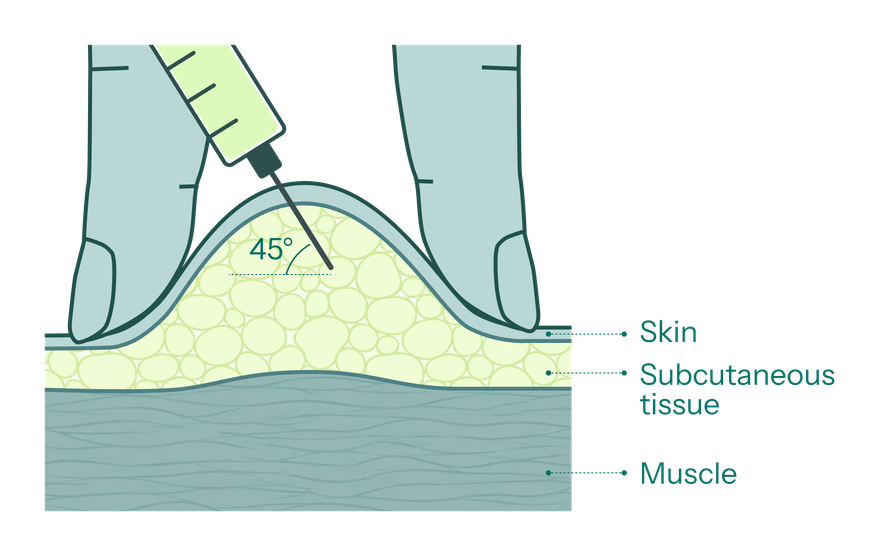
Where to inject
Compounded Semaglutide is given subcutaneously, into the fatty layer of tissue just under the skin rather than into muscle.

- Abdomen: at least an inch away from the navel.
- Thigh: the front or outer side, avoiding the knee and the groin.
- Back of the upper arm: easiest if someone can help you.
- Flank or lower back: another area with enough fatty tissue to rotate into.
A simple rotation habit
It’s easy to fall into using the same spot every time. Rotate through the left abdomen, right abdomen, and each thigh so no spot repeats two weeks running, keeping about an inch between sites.
Aftercare & disposal
- Dispose of sharps safely. Drop the used syringe into a puncture-proof sharps container, seal it when about three-quarters full, and follow your local guidance. Never put loose needles in household trash.
- Care for the site. A little redness or a small bump usually fades within a day. A cool compress helps.
- Return your vial to the fridge promptly after each use, and check that the date of first puncture is still legible on the label.
- Log your dose: the date, the units you drew, and how the week went, to make the next step conversation easier.
- Drink lots of water, especially in any week with vomiting or diarrhea.
Your dosing at a glance
Signals to adjust your dose
Your care team guides each step based on how you’re feeling and how well you’re tolerating your current dose. Pay attention to what you notice between doses and share it with us so we can decide together when it makes sense to move up, hold steady, or adjust. If you’re ever unsure, message your care team.
Message your care team ›Signs you may be ready to increase
- You’ve completed the full time your schedule sets at this step with no more than mild side effects.
- Nausea, fullness and constipation from the last increase have settled.
- Appetite and progress have leveled off, and you’re still below your target step.
Signs to hold or step back
- Nausea or vomiting that isn’t easing: report it; holding at your current dose longer is a normal answer.
- You cannot keep fluids down: this is a same-day message to your care team.
- Severe or persistent stomach pain: stop and seek help. See Read first: safety.
- Fatigue that isn’t lifting, or noticeable loss of strength: raise it with your provider (see Protein, muscle, and strength).
Tips for staying comfortable
Eat slower, and smaller
Eat slower and at regular intervals, and favor lower-fat foods over fried or greasy options. Peppermint, ginger, or probiotics may help with gut side effects.
Stay ahead of dehydration
Stick to water or clear, unsweetened drinks, and add electrolytes in any week with vomiting or diarrhea.
Keep the same day
Take your dose at the same time on the same day each week, so side effects are easier to read and a missed dose is obvious.
Safety and interactions
Do not use Compounded Semaglutide if any apply
- A personal or family history of medullary thyroid carcinoma (MTC)
- Multiple endocrine neoplasia syndrome type 2 (MEN 2)
- Pregnant, breastfeeding, or planning to become pregnant or breastfeed
- An allergy to semaglutide or any ingredient in your formulation
- You are already using another GLP-1 receptor agonist or any other semaglutide-containing product
Talk to your provider first if any apply
- You take other medicines for diabetes, including sulfonylureas or insulin
- A procedure, surgery, or colonoscopy coming up, since your procedure team may ask you to pause
- You are prescribed Compounded Semaglutide with glycine and you take clozapine (Clozaril), because glycine may interact with it and reduce its effects
- You become pregnant while taking it. Consult your care team before your next dose
Drug interactions
Tell your provider about all medicines you take, including over-the-counter drugs, vitamins, and herbal supplements; semaglutide can affect how some medicines work and vice versa. As with any prescription, this dose is for you alone, so never let anyone else use your medication.
Side effects
Compounded Semaglutide has not been evaluated by the FDA. AgelessRx members have reported the side effects below; common ones normally go away on their own within a few days, or up to 2 to 3 weeks, most likely when you start and temporarily after each increase.
Common
- Nausea
- Vomiting
- Diarrhea
- Constipation
- Stomach pain
- Indigestion
- Belching and gas
- Injection site irritation
Less common
- Headache
- Fatigue
- Dizziness
- Abdominal distension
- Acid reflux
- Gastroenteritis
- Low blood sugar, in people with type 2 diabetes
- Dehydration, as an indirect effect of vomiting or diarrhea
Rare but serious
- Pancreatitis
- Gallbladder problems
- Kidney problems
- Thyroid C-cell tumors
- Diabetic retinopathy
- Hypoglycemia
- Worsening of mood
- Allergic reactions
This is only a summary. For a fuller list of side effects and the warning signs of the serious ones, see the Mayo Clinic semaglutide resources, or ask your care team. If you are prescribed Compounded Semaglutide with glycine, see the WebMD glycine resources as well.
Troubleshooting
The solution looks cloudy, or has flakes or sediment in it
My label shows two different dates
My shipment is short a vial, or is missing supplies
I think I drew up the wrong amount
It stung or burned when I injected
Protein, muscle, and strength
Fatigue and muscle loss are common with any weight loss strategy, mostly from eating less: with less energy coming in, the body pulls from its reserves, stored in both fat and muscle. Fatigue should ease as the body adjusts to the medication and to the change in your diet.
Maintaining muscle mass takes a balance of diet, exercise, and protein: eat a moderate amount daily without over-consuming it, and exercise 3 to 5x per week, or 150 minutes. This matters most from around week 13 onward, when appetite is lowest and it’s easiest to under-eat protein without noticing.
Pairing with other treatments
Some people pair Compounded Semaglutide with NAD+ Injections. Tell your care team about anything else you take, including other AgelessRx treatments, so the combination gets reviewed at your check-in.
Frequently asked questions
How long until I notice something?
My appetite came back and I am regaining. Has it stopped working?
How long will one vial last, and why do I keep accumulating vials?
What time of day should I inject, and does food matter?
Can I take this alongside my other treatments, and who shouldn’t use it?
Do I need to pause before surgery or a colonoscopy?
Can I change the day or time when I take Compounded Semaglutide?
If you’d like to change your dosing day, discuss with your provider how to make the change safely. At least 48 hours must pass between doses.
Questions? We’re here
Your care team can help with dosing questions, side effects, a shipment issue, or anything that doesn’t feel right. Reach out any time before your next injection.
Log in to your patient portal to send a secure message, or call 650-503-9990.
Message your care team ›References and support
Injectables 101 ›- Your syringe is marked in units (1 unit = 0.01 mL). Draw to the units your prescription gives you; if your label prints a volume instead, multiply the milliliters by 100.
- Refrigerate between 36°F and 46°F; never freeze.
- Discard a vial 28 days after first puncture; unpierced vials keep for up to 180 days or until the beyond-use date on the label, whichever comes first.
- Missed a dose? Take it within 5 days, then resume your normal schedule; after that, skip it and never double up.
- For a fuller list of side effects and their warning signs, see the Mayo Clinic semaglutide resources. If your prescription is compounded with glycine, see the WebMD glycine resources as well.
- This guide is not a substitute for personal medical advice. Always consult your provider before changing your dose or routine.
Compounded Semaglutide is a compounded medication. The FDA has not reviewed these statements or approved this compounded product for any use, or for safety, efficacy, or quality. Prescription products require an online evaluation with a licensed provider who will determine if a prescription is appropriate. Risks and benefits outlined on agelessrx.com may be based on third-party studies. This guide is for general educational purposes and does not replace personalized medical advice. Always follow the instructions from your AgelessRx provider and the dosing on your prescription. If you experience a medical emergency, call 911.