
Acarbose Longevity Research: AgelessRx Trial Data

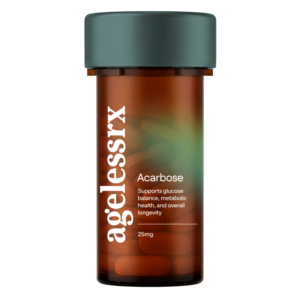
The mouse data is compelling, but our Research Team wanted to understand what this could mean for people. So, rather than wait for larger human trials, our team conducted a controlled pilot study in healthy adults and tracked participants’ real-time glucose responses. Here’s what we found.
Key takeaways:
- Acarbose extended median lifespan by 22% in male mice across three independent ITP sites
- In ITP testing, Acarbose outperformed Metformin, which showed no meaningful lifespan extension
- Our Research Team conducted a pilot trial in 12 healthy adults: 50 mg acarbose before a high-carb meal produced a 17% decrease in peak blood sugar levels with no significant tolerability differences
- Blunting post-meal glucose spikes may slow aging pathways including mTOR activation and glycation
- Pairing Acarbose with a CGM lets you see your real-time glucose response and adjust accordingly
What Is Acarbose?
Acarbose is an oral medication originally approved to help manage blood sugar in people with type 2 diabetes. It works by inhibiting alpha-glucosidase enzymes in the small intestine, which slows the breakdown and absorption of carbohydrates after meals. The result is a blunted post-meal glucose spike, which reduces the demand on the pancreas to release insulin.
What caught the longevity research community’s attention is what Acarbose does beyond glucose control. A diabetes therapy that may also slow aging? That is the kind of question that gets researchers out of bed in the morning, and it is exactly what our team set out to explore.
Why Post-Meal Glucose Spikes Matter for Longevity
Here is something most people never hear from their doctor: your fasting glucose can look perfectly fine while your body is quietly absorbing damage from every high-carb meal you eat. Persistently high blood glucose accelerates several well-documented aging pathways. Glycation, the process by which sugar molecules bind to proteins and DNA, produces advanced glycation end-products (AGEs) that stiffen tissues, promote inflammation, and impair cellular repair. Post-meal glucose spikes, even in people without diabetes, drive repeated waves of this damage throughout the day, compounding the risk of metabolic syndrome over time.
Research from the Interventions Testing Program (ITP) found that Acarbose extended median lifespan in male mice by 22%, with effects tied directly to blunting postprandial glucose excursions.
Human data points in the same direction. Higher glucose variability is associated with faster biological aging and increased cardiovascular risk, even when fasting glucose looks normal on a standard lab panel.
How Acarbose Works as a Longevity Intervention
Acarbose is an alpha-glucosidase inhibitor, a medication class originally approved for type 2 diabetes management. It works by slowing the digestion of complex carbohydrates in the small intestine, which blunts the post-meal spike in blood glucose and insulin. For longevity researchers, that mechanism is the interesting part.
Persistently high glucose and insulin are tied to accelerated biological aging through several pathways, including mTOR activation, oxidative stress, and glycation of proteins. By keeping those post-meal surges in check, Acarbose may help slow some of those aging-related processes.
About Our Pilot Trial: Study Design
The trial enrolled 12 healthy participants, including six women and six men ranging in age from 23 to 60, and used a within-subject crossover design. Each participant completed two control tests, in which they ate a plain white bagel without Acarbose, and two treatment tests, in which they took 50 mg of Acarbose before eating the bagel. CGMs tracked each participant’s blood sugar response in real time, controlling for individual metabolic differences. Our Research Team designed the within-subject protocol to capture both efficacy and tolerability data in a non-diabetic population.
Key Findings: What the Trial Revealed
Glucose and Insulin Response
Taking 50 mg of Acarbose before the high-carbohydrate bagel challenge produced a 17% decrease in peak blood sugar levels. That blunting of post-meal surges is the core mechanism through which Acarbose is thought to support longevity, and flattening those excursions reduces glycemic variability, a factor increasingly associated with cardiovascular risk and metabolic aging.
Tolerability
The trial found no significant differences in tolerability between the Acarbose and control conditions, a clean result that aligns with Acarbose’s decades-long safety record as an FDA-approved diabetes treatment.
Preclinical Evidence: What the ITP Mouse Data Shows
The ITP is one of the most rigorous longevity research programs in existence. Run across three independent sites (the Jackson Laboratory, University of Michigan, and University of Texas Health Science Center), the ITP tests compounds in genetically heterogeneous mice to reduce the odds of site-specific flukes skewing results.
Acarbose has been one of its standout performers.
What the ITP Found
In male mice, Acarbose extended median lifespan by 22%, a result that held up across all three independent testing sites. That kind of replication is rare. Female mice saw a more modest but still meaningful 5% increase. The sex difference is thought to relate to how males and females metabolize postprandial glucose differently, and figuring out exactly why is one of the more interesting open questions in the field.
A later ITP cohort went further and tested Acarbose alongside Rapamycin. The combination produced greater lifespan extension than either compound alone in males. That is not just additive math. It points to genuinely complementary mechanisms at work, which is the kind of result that makes researchers sit up straighter.
And here is what makes the numbers hold real weight: ITP trials use outbred mice that better reflect human genetic diversity, and replication across three independent labs sets a higher bar than most preclinical longevity research ever clears. This is not a one-lab outcome. This is a result that was stress-tested.
Acarbose and Gut Microbiota: A Developing Longevity Pathway
Acarbose does not just affect your blood sugar. It changes what happens further down your digestive tract, too. When Acarbose slows the breakdown of starchy carbs in the small intestine, more of that undigested starch travels down to the colon. There, your gut bacteria get to work fermenting it, and one of the byproducts they produce is a compound called butyrate. Think of butyrate as a gut health ally; it helps reduce inflammation in the intestinal lining and keeps the gut barrier strong, both of which are important for longevity.
Why the Microbiome Connection Matters
When your gut microbiome is out of balance, it can quietly drive the kind of chronic, low-grade inflammation that speeds up aging. Acarbose seems to tip that balance in a better direction by feeding the bacteria that assist complex carbs. That is a meaningful side effect worth paying attention to.
- More fermented starch means more short-chain fatty acids, which may help keep inflammation in check as you age
- A stronger gut barrier means fewer harmful bacterial byproducts leaking into your bloodstream (one less source of systemic inflammation)
The human research here is still early. But the biology is plausible, and it suggests Acarbose may be doing more for longevity than just smoothing out your post-meal glucose curve.
Acarbose vs. Metformin for Longevity
If you keep up with longevity news, you’ve probably heard of Metformin. Researchers have discussed it for decades, studied it extensively, and prescribed it to hundreds of millions of people worldwide. So when you put it next to Acarbose, the natural question is: how do they compare?
They take very different routes. Metformin works systemically, by activating a cellular energy sensor called AMPK and dialing down activity in the mitochondria. Acarbose stays in the gut. It slows the digestion of starchy carbohydrates, blunting the post-meal glucose and insulin surge before it ever reaches your bloodstream. Two treatments, two completely different mechanisms.
What the ITP Data Shows
Here’s where it gets interesting. The ITP tested both medications head to head. Acarbose extended median lifespan in male mice by 22%. Metformin, at standard doses, showed no meaningful lifespan extension in the same program.
Let that sink in. A medication you’ve probably never heard of outperformed one of the most widely discussed longevity candidates in a carefully controlled animal study.
How They Compare Across Key Dimensions
|
Feature |
Acarbose |
Metformin |
|---|---|---|
|
Primary mechanism |
Alpha-glucosidase inhibition (gut) |
AMPK activation, complex I inhibition |
|
ITP lifespan data |
+22% male, +5% female |
No meaningful extension |
|
Systemic absorption |
Minimal |
Yes |
|
Main side effects |
GI discomfort, flatulence |
GI discomfort, rare lactic acidosis |
|
Evidence in humans |
Blood sugar, some metabolic data |
Broader human trial base (TAME trial) |
Neither therapy is a proven longevity intervention in humans yet; the human trials are still catching up to the animal data. However, if you’re looking at where the preclinical evidence currently points, Acarbose has real potential. This is exactly why our Research Team decided it was worth studying in people.
CGM as a Paired Strategy for Personalized Metabolic Health
Pairing Acarbose with a Continuous Glucose Monitor (CGM) turns abstract blood sugar data into something you can actually act on, and getting started is straightforward. Instead of guessing how a meal affects postprandial glucose, a CGM shows the spike in real time, and Acarbose directly blunts that response by slowing carbohydrate absorption at the gut level. Together, they create a feedback loop: the CGM quantifies the metabolic response, and Acarbose provides a lever to modulate it.
Why This Pairing Matters for Longevity
For anyone using Acarbose as a longevity intervention, a CGM adds precision that dosing alone cannot provide.
- Postprandial glucose spikes, even in people without diabetes, are associated with cardiovascular risk and metabolic aging, making real-time visibility into those spikes genuinely useful.
- A CGM lets you identify which foods or meal compositions still produce meaningful glucose excursions despite Acarbose, so you can adjust timing, dose, or diet accordingly.
- Tracking your response over weeks helps distinguish normal day-to-day variability from a true shift in metabolic function.
This combination is particularly relevant because Acarbose’s effects depend on the dose and the meal. Having that data directly puts meaningful information at hand between clinical check-ins.
Who May Consider Acarbose for Longevity Purposes
Acarbose tends to be a good fit for health-conscious adults without a diabetes diagnosis who eat starchy carbohydrates regularly and want more control over their post-meal glucose response. That said, people taking diabetes medications, diuretics, or blood pressure medications should speak with a clinician first, and as with any prescription medication, clinician supervision is required.
Safety Profile and Tolerability
The tolerability picture from our pilot trial is straightforward: participants who took Acarbose before the bagel challenge reported no meaningful difference in side effects compared to those who did not. That lines up with what several decades of FDA-approved use in diabetes care has shown us.
Our Approach to Acarbose: Science, Research, and Care
Our Stanford PhD-led Research Team doesn’t just track the Acarbose literature, they run their own trials to understand who benefits most, which biomarkers to watch, and how dosing and timing should be personalized. Acarbose is not a one-size-fits-all tool, and that’s exactly the kind of question our team is built to answer.
If your metabolic history or biomarker picture makes Acarbose worth exploring, a consultation with a US-licensed clinician is the right starting point. They can review your health profile and help you figure out whether Acarbose belongs in your protocol and at what dose.
Note: The above statements have not been evaluated by the Food and Drug Administration. This product is not intended to diagnose, treat, cure, or prevent any disease.