NAD+ Face Cream: Does It Work?

NAD+ decline shows up most visibly in the skin. So it makes sense that topical NAD+ products have taken off. But how NAD+ works in cells raises a real question: can a cream actually get the job done? Here’s what the science says, and what it means for anyone looking into this category.
Key takeaways:
- Our Rx-grade NAD+ Face Cream delivers pure NAD+ powder directly to skin
- Niacinamide improves hydration and pigmentation but does not replicate systemic NAD+ replenishment
- Skin aging from NAD+ loss starts at the cellular level, where topical products cannot reach
- We offer an Rx-grade NAD+ Face Cream for targeted skin support, NAD+ Injections, NAD+ Nasal Spray, and NAD+ Patches for systemic replenishment
What is NAD+?
NAD+ (nicotinamide adenine dinucleotide) is a coenzyme found in every cell in the body. Its main jobs are converting nutrients into energy, repairing damaged DNA, and activating sirtuins. Sirtuins are proteins that help cells handle stress and stay structurally sound over time.
Skin cells have an unusually high demand for NAD+. They face daily UV radiation, pollutants, and a constant cycle of turnover. All of that requires steady energy and repair. When NAD+ runs low, skin cells lose their ability to fix oxidative damage efficiently. That is a key reason why aging skin looks the way it does.
Why NAD+ Levels Drop with Age
NAD+ decline with age isn’t simply a matter of making less of it. Two things happen at once. Biosynthesis slows as the enzymes that produce NAD+ become less active. At the same time, demand from NAD+-consuming enzymes like PARP (which repairs DNA damage) and CD38 (an enzyme that rises sharply with age-related inflammation) keeps increasing. The result is a growing gap between supply and demand at the cellular level.
Measuring NAD+ in whole blood can give an incomplete picture. Red blood cells have minimal metabolic demand for NAD+ compared to tissues like muscle, liver, and brain, so whole-blood readings don’t reliably capture what is happening at the organ level. At the tissue level, research shows NAD+ has been found to fall in human skin, cerebrospinal fluid, and brain tissue with age. The pattern of NAD+ decline with age is well-documented in tissue and organ studies, even when blood measurements appear stable.
What Declining NAD+ Means for Skin
As NAD+ levels fall in skin cells, they trigger layered effects. Skin is the body’s most UV-exposed organ, so its cells constantly accumulate DNA strand breaks and oxidative lesions. PARP enzymes depend on NAD+ to patch that damage. Without enough NAD+, unrepaired lesions build up and cell function degrades.
Fibroblasts are the cells that produce collagen and elastin. They are metabolically demanding and lose the mitochondrial energy output they need to keep up protein production. Skin firmness declines as a result.
Sirtuin activity drops in parallel. Without enough NAD+ to activate them, the stress-buffering capacity that governs how skin cells respond to inflammation weakens. This contributes to what researchers call inflammaging at the dermal level, a low-grade, chronic inflammatory state that degrades structural proteins and accelerates visible aging. It is one expression of the broader hallmarks of aging operating at the cellular level.
The marketing language around NAD+ face creams (cellular repair, radiance, wrinkle reduction) does point to real biology. The harder question is whether a topical cream can reach the dermal layer where that biology is happening.
What NAD+ Face Creams Actually Contain
The ingredient lists in this category vary more than the product names suggest. Most commercial face creams marketed around NAD+ rely on niacinamide, a form of vitamin B3 the body uses as a precursor to build NAD+. Some include NMN (nicotinamide mononucleotide) or NR (nicotinamide riboside), which sit further along the biosynthetic pathway but still require enzymatic conversion steps.
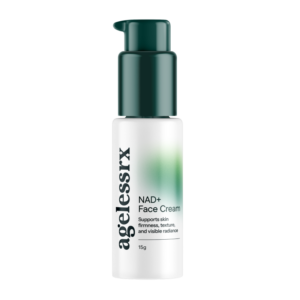
Our NAD+ Face Cream is formulated differently. It contains pure NAD+ powder as the active ingredient. It is a prescription-grade formula, meaning it goes through a clinician-guided evaluation before dispensing. That positions it in a separate category from mass-market creams that reference the NAD+ pathway without delivering the coenzyme itself.
The Bioavailability Problem with Topical NAD+
Daltons measure molecular weight, essentially how large a molecule is. Cosmetic science has long recognized 500 Daltons as the rough upper limit for passive skin penetration through the outermost layer, the stratum corneum. This threshold is well-grounded in the pharmacological literature and confirmed by recent dermatological research as a standard filter for judging topical ingredient viability.
What Niacinamide Can and Cannot Do
Niacinamide is a genuinely effective skincare ingredient that deserves credit for what it does. At concentrations around 5%, clinical studies show it improves skin hydration, reduces hyperpigmentation, and supports barrier function.
What niacinamide cannot do is replicate what raising intracellular NAD+ levels systemically would accomplish. When applied topically, research suggests it can contribute to local NAD+ biosynthesis in skin cells to some degree. But the pathway from topical niacinamide to meaningful intracellular NAD+ repletion in dermal fibroblasts involves multiple conversion steps. Each step depends on enzymatic activity that varies by cell type, skin depth, and individual biology.
Think of it like sending a bag of raw coffee beans to someone who needs a finished cup of coffee. The beans are genuine, useful starting material, but getting to the end result still requires a grinder, a machine, and the right conditions to come together. Niacinamide is similarly a real building block for NAD+, but turning it into intracellular NAD+ inside the cells that need it most requires those enzymatic conversion steps to work correctly, in the right cell type, at the right depth.
Niacinamide primarily supports the surface and upper epidermal layers, where it improves barrier function and pigmentation. A longevity intervention targeting NAD+ depletion works at the mitochondrial and nuclear level across tissues throughout the body. These are different mechanisms, with different delivery requirements and a different evidence base.
Why Systemic NAD+ Replenishment Is a Different Category
Topical NAD+ delivery targets the skin’s surface layers. Systemic NAD+ replenishment works from inside every cell across the body.
When NAD+ is delivered through a route that bypasses absorption barriers, such as injection or nasal delivery, it reaches cells throughout the body, well beyond the skin’s upper layers. Sirtuin activation, mitochondrial energy output, and PARP-driven DNA repair all operate at the intracellular level across organ systems. These are the mechanisms the research literature is studying, extending to questions like whether boosting NAD+ can affect Alzheimer’s.
Skin improvements that follow systemic replenishment are a downstream effect of that broader cellular recovery. When fibroblasts have enough energy and DNA repair capacity restored, collagen production and stress resilience improve as natural consequences. For targeted support at the epidermal level, our NAD+ Face Cream addresses that layer directly. For full-body cellular NAD+ repletion, the systemic formats extend that work throughout every tissue.
How Non-Oral NAD+ Delivery Works
Subcutaneous injection delivers NAD+ directly into tissue beneath the skin. It enters circulation without passing through the digestive tract. Oral NAD+ precursors, by contrast, get broken down in the gut and must be reassembled through multiple enzymatic steps inside cells. Injection sidesteps that entire conversion sequence.
The NAD+ Nasal Spray takes a different route. The nasal mucosa is highly vascularized, so molecules absorbed there pass into systemic circulation rapidly without gut-mediated degradation. That makes intranasal delivery a practical option for people who prefer to avoid injections. It still reaches circulation more directly than any oral format.
Transdermal patches work differently from standard creams. NAD+ Patches use specialized carrier systems designed to drive active compounds across the skin barrier and into systemic circulation over time. The key difference from a topical cream is formulation engineering. Patches use transdermal absorption to deliver NAD+. Most creams remain within the epidermal layers.
All three formats share one key advantage. They route NAD+ into the body without relying on the digestive system, where much of the molecule would otherwise be lost before reaching cells.
|
Delivery Method |
How It Works |
Bypasses Digestion? |
Reaches Systemic Circulation? |
Key Limitation |
|---|---|---|---|---|
|
NAD+ Injection |
Subcutaneous injection into tissue beneath the skin |
Yes |
Yes, absorbed into circulation from tissue |
Requires self-injection; clinician guidance needed |
|
NAD+ Nasal Spray |
Absorbed through the highly vascularized nasal mucosa |
Yes |
Yes, rapid systemic absorption |
Less familiar route for some users |
|
NAD+ Patch |
Transdermal absorption via specialized carrier systems |
Yes |
Yes, absorbed into circulation over time |
Slower, time-release delivery |
|
NAD+ Face Cream (Specifically from AgelessRx) |
Rx-grade cream formulated with pure NAD+ as the active ingredient; delivers NAD+ directly to epidermal skin cells |
Yes |
No; targets epidermal skin cells, not systemic circulation |
Supports surface skin repair; does not reach deep dermal or systemic targets |
Starting NAD+ with AgelessRx
NAD+ depletion genuinely drives the skin changes you see with age, so interest in this biology is not misplaced. The gap is in delivery. As longevity science matures, the question researchers and clinicians are increasingly focused on is not whether NAD+ supports cellular health (that is well-settled) but how to raise it reliably at the intracellular level across tissues. That framing, root-cause biology tackled at the delivery level, is where our work is anchored. It puts you in a meaningfully different position than a trip down the skincare aisle.
Every NAD+ format through AgelessRx, including NAD+ Face Cream, is prescription-grade and starts with an online consultation. A US-licensed medical provider reviews your health history and determines which format, if any, is appropriate for your goals. Benefits are based on third-party studies and self-reported customer data; individual results may vary.
Note: The above statements have not been evaluated by the Food and Drug Administration. This product is not intended to diagnose, treat, cure, or prevent any disease.