
Can NAD+ Affect Your Sleep?

Sleep changes as we age. Most people accept this as inevitable. But what if it’s actually a biochemical problem with a solution?
The answer may lie in NAD+, a coenzyme that controls energy, DNA repair, and sleep regulation.
Key takeaways:
- NAD+ levels follow a circadian rhythm and drop up to 50% with age
- Low NAD+ reduces time in restorative deep sleep
- NMN taken in the afternoon may improve sleep quality scores in older adults
- Exercise, fasting, limiting alcohol, and a consistent sleep schedule support NAD+ production
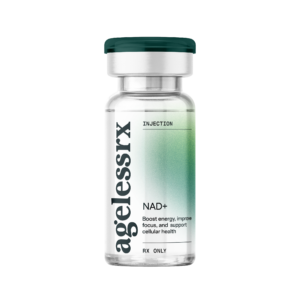
- AgelessRx NAD+ Injections bypass digestive breakdown for more direct cellular delivery
What Is NAD+?
It plays two roles that matter most for sleep: it helps mitochondria generate cellular energy, and it activates a group of proteins called sirtuins, particularly SIRT1, that control the genes running the internal clock.
The body cannot absorb NAD+ from a supplement. It has to make it from precursor molecules. The two most studied are NMN (nicotinamide mononucleotide) and NR (nicotinamide riboside), both of which the body converts into NAD+. Understanding how this process works is what makes NAD+ so directly tied to how well you sleep.
How NAD+ Affects Sleep
The body operates on an internal clock known as the circadian rhythm. This 24-hour cycle responds to light and darkness, synchronizing bodily functions with the environment.
What if we told you NAD+ levels are tied to this rhythm?
Research has shown that NAD+ levels naturally rise and fall in a daily rhythm, synced to light-dark cycles just like your sleep schedule. This daily pattern in NAD+ may help keep sleep cycles on track and support the cellular repair that happens while you rest.
But here’s the problem: as we age, our NAD+ levels decline.
This decline can be steep. Research shows levels can drop by up to 50% during the course of adult aging. The effects go well beyond fatigue, touching every stage of sleep and the biological processes that depend on it.
How Declining NAD+ Disrupts Sleep
When NAD+ levels fall, circadian rhythm suffers. The system that controls the sleep-wake schedule starts to malfunction.
The result? Your sleep gets off track. You may struggle to fall asleep or wake up tired, even after a full night’s rest.
Research has found that decreases in NAD+ levels have been associated with circadian and sleep-wake disruptions. This drop may impact sleep quality, often leaving individuals feeling unrested despite following a normal sleep schedule.
Part of this comes down to a protein called SIRT1, which NAD+ helps power. SIRT1 controls two genes, CLOCK and BMAL1, that act as the body’s internal timer. When NAD+ runs low, SIRT1 slows down and that timer loses accuracy. Sleep timing shifts, nighttime waking becomes more frequent, and sleep gets shallower over time.
SIRT3, another protein in this family, works inside the mitochondria, which are the cell’s energy-generating structures. It may help keep cells stable and energized enough to support healthy sleep cycles. Like SIRT1, SIRT3 also needs NAD+ to function. When NAD+ is low, SIRT3 activity may drop, and the body may spend more time in lighter sleep stages, cutting into deeper, more restorative rest.
This may explain why many older adults experience insomnia, early waking, and reduced deep sleep.
Can Boosting NAD+ Improve Sleep?
The latest research looks promising.
A rigorous clinical study found that taking NMN in the afternoon improved sleep quality in older adults. Timing appears to matter here. Taking NAD+ precursors later in the day may line up better with the body’s natural rise in NAD+ activity toward the evening, which supports the repair work the body does during nighttime sleep.
Participants showed notable reductions in daytime dysfunction scores on the Pittsburgh Sleep Quality Index.
Another study in mice found that dietary supplementation with nicotinamide riboside improved sleep efficiency. The mice spent less time in non-REM sleep while still appearing to meet their sleep needs. This would be equivalent to reducing human sleep from 8 to 6.6 hours while feeling just as rested.
Risks and Considerations of NAD+ Injections
NAD+ Injections are generally well-tolerated, but there are a few things worth knowing before starting.
Mild side effects are possible. Some people report temporary discomfort at the injection site, mild nausea, or a warm flushing sensation, especially at higher doses. These effects tend to be short-lived and often ease as the body adjusts.
Timing may matter for sleep. Some users find that taking NAD+ Injections in the morning works better for them, since NAD+ can have an energizing effect. Taking it too close to bedtime may make it harder to fall asleep for certain individuals, though this varies from person to person.
Long-term data is still building. Research on NAD+ Injections is promising, but the long-term safety picture is still emerging. People who are pregnant, breastfeeding, or taking medications that affect cellular energy metabolism should check with a clinician before starting.
Clinician oversight is part of the process. AgelessRx NAD+ Injections are prescribed and monitored by licensed clinicians, which means dosing and protocol are tailored to your health profile rather than a one-size-fits-all approach.
Supporting NAD+ Through Lifestyle
While NAD+ precursor supplements show promise, they’re not the only way to support healthy NAD+ levels.
Several lifestyle factors may influence NAD+ production:
|
Lifestyle Factor |
How It Helps NAD+ |
Key Mechanism |
|---|---|---|
|
Exercise |
May raise NAD+ availability |
Muscle cells demand more NAD+, signaling the body to ramp up production. Both cardio and strength training contribute. |
|
Fasting |
Boosts NAD+ production |
Activates key biosynthesis enzymes and lowers competing demands on NAD+ since the body is no longer processing food. |
|
Limiting alcohol |
Preserves NAD+ stores |
Reduces liver depletion caused by alcohol processing and protects the natural daily NAD+ rhythm the body depends on for nighttime repair. |
|
Consistent sleep schedule |
Optimizes NAD+ cycling |
Reinforces the light-dark signals that drive the circadian NAD+ oscillation. Even small timing inconsistencies can blunt this cycle. |
The Future of Sleep Enhancement
Many people accept poor sleep as a normal part of getting older. Longevity research is now zeroing in on the biological reasons behind it. Restoring NAD+ levels takes a root-cause approach. It targets the cellular and circadian disruptions that cause sleep to decline with age, not simply covering up the symptoms.
The NAD+ pathway may turn out to be a key link between all of these areas of health, with sleep quality acting as both a sign and a driver of how well cells are functioning. Treatments that combine Sermorelin and NAD+ offer a growing approach to targeting both hormonal and cellular aspects of longevity.
What the Latest Research Is Saying (2025-2026)
The picture for NAD+ and sleep continues to get sharper. A 2026 PRISMA-guided review covering NAD+ supplementation across multiple aging outcomes confirmed that NAD+ augmentation produces clear biological activity, including measurable effects on circadian-linked pathways, though the authors noted that larger, longer clinical trials are still needed to pin down the full scope of sleep-specific benefits in healthy older adults.
On the trial front, a registered study called NADream is actively examining the effects of NAD+ supplementation on sleep quality in healthy individuals. The trial is built around the mechanistic hypothesis that higher NAD+ levels support better sleep by restoring mitochondrial function and reducing oxidative stress (two processes this post has covered in depth). Results from NADream will add to the growing body of human trial data on this topic.
One finding worth knowing: a 2025 trial in long COVID patients found that nicotinamide riboside (NR) raised NAD+ levels within five weeks but did not produce a statistically significant improvement in sleep scores compared to placebo in that specific population. Researchers note that post-viral fatigue creates a distinct physiological context from typical age-related NAD+ decline, so these findings don’t contradict the existing sleep literature for healthy aging adults, but they do reinforce the importance of matching the right intervention to the right population.
Note: The above statements have not been reviewed by the Food and Drug Administration. This product is not intended to diagnose, treat, cure, or prevent any disease.