
GHK-Cu Peptide: How It Works and What Research Shows

Every so often, a molecule comes along that makes you stop and think, wait, how is this not talked about more? GHK-Cu is exactly one of those. Skin repair, wound healing, gene regulation, hair follicle support, and more. Unlike many ingredients that get this kind of attention, the science here is actually worth reading. So, let’s walk through it together: what GHK-Cu is, how it works at the cellular level, and where the evidence genuinely holds up.
Key Takeaways
- GHK-Cu is a naturally occurring copper peptide that declines with age, dropping from roughly 200 ng/mL in young adults to around 80 ng/mL by age 60.
- Research suggests it may support skin repair, hair regrowth, wound healing, and anti-aging by influencing genes tied to tissue repair and cellular renewal
- Dosage protocols vary by goal and are best determined by a US-licensed clinician based on individual health context
- Side effects are generally mild at recommended doses; sourcing from a clinically supervised provider matters for safety
- GHK-Cu is not FDA-approved, so quality and oversight vary widely
What Is GHK-Cu?
Let’s start with the basics. The science behind GHK-Cu shows that it is a naturally occurring copper peptide found in human plasma, saliva, and urine. It consists of a tripeptide sequence (glycyl-L-histidyl-L-lysine) bound to a copper ion, and it plays a role in tissue repair, wound healing, anti-inflammatory signaling, and cellular communication. Your body makes this molecule. It has been doing so since before you were born.
GHK-Cu declines with age. Plasma levels drop from roughly 200 ng/mL at age 20 to around 80 ng/mL by age 60. Researchers have connected this drop to reduced regenerative capacity, a pattern also visible in phenotypic age markers over time. In other words, as GHK-Cu fades, so does a lot of the body’s ability to repair and renew itself.
How the GHK-Cu Peptide Works at the Cellular Level
Here’s where the science gets interesting. GHK-Cu binds to copper ions and carries them into cells, where copper acts as a cofactor for enzymes involved in collagen synthesis, antioxidant defense, and tissue repair. The peptide also binds to DNA and activates gene expression programs tied to wound healing, anti-inflammatory signaling, and cellular renewal. A small peptide influencing how genes behave is a bigger deal than it might sound.
Research suggests GHK-Cu may shift aging gene expression patterns in older cells toward profiles more closely associated with younger tissue. One analysis found that GHK-Cu influenced the expression of approximately 31% of the genes evaluated, including pathways related to inflammation, oxidative stress, and tissue remodeling.
GHK-Cu Benefits for Skin: What the Research Shows
GHK-Cu is a well-studied peptide in skin research, and once you start reading the findings, it is genuinely hard not to get excited. Let’s walk through what the science actually shows, and why it holds up better than most ingredients in this space.
Collagen and Wound Repair
Research suggests GHK-Cu may stimulate collagen production while also breaking down damaged collagen. This two-part action supports skin remodeling, not just tissue buildup. Researchers often connect it to faster wound healing and better skin elasticity.
Antioxidant and Anti-Inflammatory Activity
Research shows GHK-Cu may lower oxidative stress and reduce inflammation in skin tissue. Think of oxidative stress and chronic low-grade inflammation as the slow burn behind most visible aging. GHK-Cu appears to turn that down. One review found measurable improvements in skin firmness, density, and fine lines after 8 to 12 weeks of topical use, with some participants seeing reductions in dark spots and roughness as well. And a note worth keeping in mind: the strongest human data here comes from topical formulations, not injections.
GHK-Cu for Hair: What the Evidence Supports
If GHK-Cu can do this much for skin, it’s natural to ask what it might do for hair. The case is considered plausible in the research, and the biology behind it makes sense. Copper plays a role in the enzymes that build hair structure, and the peptide may help reduce scalp inflammation that can slow follicle function. Some early research suggests GHK-Cu may support the active growth phase of the hair cycle and promote follicle activity. Most of this evidence comes from lab or animal studies, not large human trials, so more research is still needed.
Topical vs. Injectable GHK-Cu
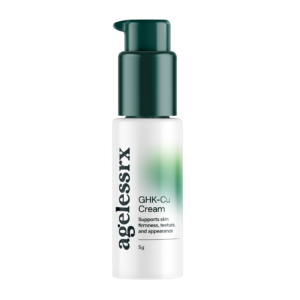
For most people, the GHK-Cu Cream is where the evidence points. Topical formulations carry the strongest human trial data, the most favorable safety profile, and the clearest clinical rationale. The injectable form exists in the research literature, but the human evidence is very limited. Understanding the difference is useful context, not a decision framework for most readers.
|
Topical |
| |
|---|---|---|
|
Depth of reach |
Outer skin layers only |
Enters circulation; reaches tissues throughout the body |
|
Best for |
Fine lines, uneven texture, skin barrier repair |
Systemic tissue repair, wound healing, hair follicle support |
|
Typical concentration / dose |
0.1% to 3% concentration |
No established human dosing data; clinician-guided only |
|
Human trial data |
Most skin studies use topical; 12-week trials show improvements in laxity, density, and fine lines |
More limited for skin-specific outcomes; used in wound repair and hair regrowth research |
|
Systemic absorption |
Limited |
High; bypasses the skin barrier entirely |
|
Prescription required? |
Yes; requires a prescription |
FDA restricted; not currently available through AgelessRx |
Here’s what the topical form has going for it: real human trials, real outcomes, and a safety profile that holds up under scrutiny. The molecule penetrates the outer layers of skin, and that’s exactly where the evidence lives. Studies using creams and serums showed measurable improvements in skin laxity, density, and fine lines. That’s not speculation. That’s data you can point to.
Injectable GHK-Cu is a different story. Human evidence for the injectable form is very limited. The available data comes largely from animal studies and self-reported use outside of clinical settings. There are no established dosing protocols supported by peer-reviewed human trials, and long-term safety in humans has not been studied. The injectable form is covered here as educational context. The topical cream is the recommended option for people looking to act on the science today.
GHK-Cu Dosage and Protocol
Dosage with GHK-Cu is not one-size-fits-all, and that’s by design. How much you use depends on your goals, your health history, and the form you choose. The guidance below comes from research and clinical practice.
Topical Formulations
Studies on creams and serums have used a range of concentrations depending on the intended use. Lower concentrations are common in everyday products for fine lines and texture, while higher concentrations show up in products studied for wound healing and skin barrier repair. Starting at the lower end is common when trying a new topical product.
Injectable Protocols
There is currently no established human clinical data to guide injectable GHK-Cu dosing. Any protocol would need to be managed by a US-licensed clinician based on your individual goals and health history. Given how early the evidence is with injectables, using it without proper clinical oversight is not advisable.
The right dose depends on individual goals, copper levels, and overall health. Any injectable GHK-Cu protocol should be managed by a US-licensed clinician. Using it without oversight can lead to improper dosing, sourcing problems, and copper buildup that goes unchecked. This is especially worth keeping in mind given that injectable GHK-Cu remains understudied in human populations.
Side Effects and Safety Profile
The good news here is that topical GHK-Cu has a strong safety record in research, with most human studies on topical formulations reporting no serious side effects at standard doses. When side effects do occur, they tend to be mild and short-lived. With the injectable form, the most common reactions are localized to the injection site, such as redness, swelling, or minor irritation, and these typically clear within a few hours. Some people report mild fatigue or a slight headache in the first few days, but this usually fades as the body adjusts. With topical use, side effects are generally limited to minor skin irritation or redness at the application site, which is uncommon at standard concentrations. In other words, most people tolerate the topical form well. For injectable GHK-Cu, it is worth noting that more robust human data is still needed on both effectiveness and long-term safety.
Who Should Use Caution
- People with copper metabolism disorders (such as Wilson’s disease) should not use GHK-Cu in any form, injectable or topical, without clinician guidance. The peptide carries a copper ion that could affect the body’s copper balance.
- People taking immunosuppressants should talk to a US-licensed medical provider before using GHK-Cu in any form, as it may interact with these medications.
- Pregnant or breastfeeding individuals have no safety data to rely on, so use is not recommended.
Unlike some peptides that interact with the endocrine system, GHK-Cu does not appear to affect hormones, which gives it a relatively clean risk profile for most users. It also pairs well with antioxidants like Glutathione Nasal Spray and is commonly layered into broader longevity protocols without issue. At appropriate doses and under proper guidance, this is one of the more approachable peptides to work with.
GHK-Cu Peptide Benefits, Dosage, and How to Get It Safely
GHK-Cu has real science behind it, and the topical cream is where that science is best supported. Human trials on topical formulations show measurable improvements in skin laxity, density, and fine lines. The mechanism is well-documented. The safety profile is clean. If you want to act on the research, the topical form is the logical place to start.
The injectable form is a different conversation, one that belongs in a clinical setting with a US-licensed clinician who can assess your individual health context. The human evidence is still in early stages, and there are no established protocols supported by peer-reviewed trials. This post covers it as background so you understand the full picture, not as a recommendation.
GHK-Cu is not FDA-approved in any form, so sourcing and oversight matter. The GHK-Cu Cream is the right place to start for anyone ready to take a science-backed approach to skin and cellular health.
Curious how this applies to a specific peptide? See our deep dive on what regenerative medicine is.
Note: The above statements have not been reviewed by the Food and Drug Administration. This product is not intended to diagnose, treat, cure, or prevent any disease.