
Methylene Blue Dosing: Debunking Misconceptions About Safety

Methylene Blue (MB) has a unique dual identity. At low doses (under 30 mg/day), it’s being studied as a brain-boosting supplement that may help with focus, energy, and protecting brain cells. At high doses (100 mg to 1000 mg/day), it’s used in hospitals to treat serious conditions like malaria, septic shock, and cyanide poisoning. Despite its long history of use, myths about MB’s safety still cause a lot of confusion. Many of these fears come from mixing up the effects of high doses with those of much lower, wellness-focused ones.
The problem? Even though Methylene Blue has a long history of safe use, many people worry it lowers nitric oxide (NO), which could affect blood flow and heart health. But what most people don’t realize is that this effect depends on the dose, and it’s mainly seen at very high medical doses.
This is a key difference that changes how we should think about Methylene Blue’s safety. At low doses, the concerns about nitric oxide don’t really apply. This is why it’s important to understand the full picture before making judgments. Most low-dose cognitive protocols fall between 0.5-4 mg/kg, or roughly 1-30 mg/day, and many people start conservatively at 1-4 mg before adjusting the amount upward over time under clinician guidance.
Key Takeaways:
- Low-dose Methylene Blue (under 30 mg/day) and high-dose (100-1000 mg/day) affect the body in very different ways
- Nitric oxide inhibition occurs at very high doses (above 250 mg, typically IV), not at the low wellness doses used for cognitive support
- At low doses, Methylene Blue acts as an alternative electron carrier, boosting ATP and reducing oxidative stress
- Serotonin syndrome risk becomes clinically relevant only above 250 mg or when combined with SSRIs
- People with G6PD deficiency should get an enzyme test and consult a clinician before starting Methylene Blue
How Does Methylene Blue Work?
To understand why dose matters so much with Methylene Blue, it helps to understand what it actually does inside your cells. MB’s most important mechanism is its role as an alternative electron carrier in the mitochondrial electron transport chain (ETC), the system cells use to generate ATP (adenosine triphosphate), the molecule that powers almost every biological process.
The Electron Transport Chain: A Quick Primer
Mitochondria produce energy by passing electrons through a series of protein complexes (Complex I through IV) embedded in the inner mitochondrial membrane. This process drives the production of ATP. Think of it as an assembly line: electrons enter at one end and, by the time they exit, your cell has harvested usable energy.
The problem is that this assembly line breaks down with age, illness, and oxidative stress. Complexes I and III are the two segments most vulnerable to dysfunction. When they are damaged or inefficient, the chain stalls, electron flow backs up, and cells produce less ATP while generating more harmful reactive oxygen species (free radicals) as a byproduct.
Methylene Blue as an Alternative Electron Carrier
MB can accept electrons directly from NADH (the electron donor that feeds Complex I) and donate them to cytochrome c, which sits downstream of Complex III. In plain terms, it creates a shortcut around damaged or sluggish segments of the chain. This allows electron flow and ATP production to continue even when Complexes I or III are impaired.
This bypass works because MB is a redox-cycling molecule. In its oxidized form (blue), MB accepts electrons and is reduced to leucomethylene blue (colorless). It then passes those electrons to oxygen or cytochrome c, oxidizes back to its blue form, and repeats the cycle. This continuous cycling is what allows MB to act as a functional substitute for a compromised segment of the ETC instead of a one-time antioxidant.
The Result: More ATP, Less Oxidative Stress
Because MB keeps electrons moving through the chain, two things happen simultaneously:
- ATP production increases. Cells that were energy-starved due to ETC dysfunction regain the ability to generate fuel efficiently.
- Free radical production decreases. Electron backlog is the primary driver of reactive oxygen species in mitochondria. By clearing the bottleneck, MB reduces the oxidative stress that accumulates when electrons leak out of a stalled chain.
This dual effect, more energy output with less cellular damage, is the core reason researchers are interested in low-dose MB for brain health. Neurons are especially energy-hungry and especially vulnerable to oxidative damage, a challenge that grows as cellular NAD+ levels fall with age and mitochondrial output slows.
Importantly, this electron-carrier mechanism operates at low doses. At higher concentrations, MB’s chemistry changes and it can generate oxidative stress instead of reducing it. This is the hormetic dose-response described in the next section.
What Is the Difference Between Low-Dose and High-Dose Methylene Blue?
Methylene Blue exists in two distinct dosing worlds, each with different applications and safety considerations:
|
Low-Dose Methylene Blue |
High-Dose Methylene Blue | |
|---|---|---|
|
Dose range |
Under 30 mg/day |
100-1,000 mg/day |
|
Primary use |
Mitochondrial enhancement, neuroprotection, cognitive support |
Medical treatment (malaria, septic shock, methemoglobinemia, cyanide poisoning) |
|
Administration |
Oral supplement |
Typically IV in a hospital setting |
|
Nitric oxide effect |
No meaningful reduction; may support brain blood flow |
Inhibits nitric oxide synthase (NOS); clinically useful in septic shock |
|
Serotonin syndrome risk |
Very low at this dose range |
Clinically meaningful above 250 mg or when combined with SSRIs/MAOIs |
|
Oxidative stress |
Reduces oxidative stress via ETC bypass |
Can generate oxidative stress at high concentrations |
|
G6PD deficiency risk |
Low; consult a clinician before use |
Increased risk of hemolysis |
Low-Dose Methylene Blue (<30 mg/day) functions primarily as a mitochondrial enhancer and neuroprotective agent. At this dosage, it improves how well cells work, lowers stress on the body, and supports clear thinking without meaningful risk of side effects.
High-dose Methylene Blue (100 mg to 1000 mg per day) is used as a strong medical treatment for serious conditions like malaria, septic shock, and methemoglobinemia. These doses are given in hospitals, usually through an IV.
It’s important to understand the difference between high and low doses because they affect the body in very different ways. Methylene Blue works through something called a hormetic effect. This means small doses can be helpful, but very high doses can be harmful. The side effects seen with high doses don’t necessarily happen at the much lower doses used for brain health and wellness.
Does Methylene Blue Lower Nitric Oxide?
Perhaps one of the most common myths about Methylene Blue is its effect on nitric oxide (NO) pathways. Some people say MB is dangerous because it lowers nitric oxide, which could affect heart health and blood flow. However, this claim ignores the point that MB’s effects depend on the dose.
At high doses (above 250 mg and often delivered through an IV), MB may inhibit nitric oxide synthase (NOS), the enzyme responsible for NO production. This effect is actually beneficial in conditions like septic shock, where excessive NO causes dangerous vasodilation and critically low blood pressure.
However, at low doses (below 30 mg), research indicates MB does not meaningfully reduce nitric oxide levels. In fact, by improving how well mitochondria work and reducing oxidative stress, low-dose MB may actually enhance blood flow in the brain.
What Are the Common Safety Misconceptions About Methylene Blue?
The confusion around Methylene Blue extends beyond its nitric oxide interactions.
MAOI Activity and Serotonin Syndrome Risk
Methylene Blue has weak MAOI activity, which has led to warnings about serotonin syndrome. This is a real concern at high doses or when combined with certain medications like SSRIs, opioids, or other MAOIs. But at low supplement doses, this risk is very low and usually not something to worry about.
Methylene Blue is a potent reversible MAO-A inhibitor. This means it can increase the risk of serotonin syndrome when combined with certain serotonergic medications. Published cases have primarily involved people taking serotonergic drugs, including SSRIs, SNRIs, MAOIs, and other medications that affect serotonin signaling. Importantly, there is no established dose below which this interaction is considered risk-free, and serotonin toxicity has been reported with intravenous Methylene Blue at doses around 1 mg/kg.
For context, research has described neurometabolic effects of Methylene Blue at doses of 0.5-4 mg/kg. However, this range should not be interpreted as a confirmed safe range when serotonergic medications are involved.
Anyone taking an antidepressant, psychiatric medication, or other serotonergic drug should talk with their prescribing clinician. This should happen before starting Methylene Blue at any dose.
The “Toxic at Any Dose” Myth
Some critics claim MB is inherently toxic regardless of dosage. This contradicts its role in medicine for over a century and inclusion on the World Health Organization’s List of Essential Medicines.
Low-dose MB has shown a strong safety profile in multiple clinical studies, with participants generally reporting good tolerability. Several studies have looked at MB’s cognitive enhancement effects in humans and found excellent tolerability at low doses.
Dosing Considerations for G6PD Deficiency
While many MB concerns are misconceptions, the interaction with G6PD deficiency deserves careful attention.
G6PD (glucose-6-phosphate dehydrogenase) deficiency is a genetic enzyme disorder affecting red blood cell stability. Individuals with this condition face increased risk of hemolysis (red blood cell breakdown) when exposed to certain oxidative stressors, including high-dose Methylene Blue.
Low-dose Methylene Blue is not likely to cause hemolysis (a type of red blood cell damage). However, people with G6PD deficiency should talk to a clinician or US-licensed provider before using it. Are you unsure whether you have G6PD deficiency? A simple enzyme test can help you find out before starting MB.
Product Quality and Sourcing Considerations
Methylene Blue is sold in industrial, technical, and pharmaceutical grades, and only pharmaceutical-grade or USP-grade product should be used for supplementation. Industrial-grade MB may contain heavy metal contaminants that make it unsafe for human consumption. Source MB from a licensed compounding pharmacy or a reputable manufacturer that provides third-party purity testing and a certificate of analysis.
Capsule Form: What to Expect
Pharmaceutical-grade Methylene Blue is available in oral capsule form, which offers measured, consistent dosing. Each capsule contains a fixed, pre-measured amount, making it straightforward to stay within the low-dose wellness range (under 30 mg/day) and to titrate upward incrementally under clinician guidance.
Capsules are the preferred delivery form for low-dose cognitive and longevity protocols for several practical reasons:
- Dose accuracy: Each capsule delivers a consistent milligram amount, reducing the risk of accidental overdose
- Stability: Encapsulation protects MB from light and air degradation, preserving potency over the product’s shelf life
- Convenience: Fixed-dose capsules make it easy to track daily intake and maintain a consistent protocol
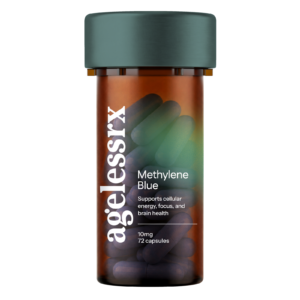
When choosing a product, confirm the capsule contains only pharmaceutical-grade or USP-grade MB and that the manufacturer provides a certificate of analysis from a third-party lab. Avoid any product that does not disclose its grade or sourcing. AgelessRx’s Methylene Blue is dispensed as pharmaceutical-grade capsules through a licensed compounding pharmacy, with clinician oversight built into every prescription.
Can Methylene Blue Improve Cognitive Function?
Beyond safety considerations, low-dose Methylene Blue shows promising cognitive benefits supported by research.
A neurological study showed MB’s memory-enhancing effects and dose-dependent impact on brain oxygen consumption. At low doses, MB improved memory retention and increased cytochrome oxidase activity, enhancing neuronal metabolism.
The cognitive benefits appear to stem from MB’s ability to enhance mitochondrial function, improve cellular energy production, and reduce oxidative stress in neural tissues.
The Future of Methylene Blue Research
Methylene Blue shows a core principle in medicine and nutritional science: dosage determines effect. The same compound that saves lives in emergency rooms at high doses can support cognitive and mitochondrial health at low doses to help combat brain aging.
Researchers are also looking at MB’s potential role in neurodegenerative conditions. Early research is studying whether MB may help inhibit the buildup of tau protein tangles and reduce amyloid plaque accumulation, two hallmarks of Alzheimer’s disease pathology. Preliminary research suggests these effects could stem from MB’s ability to support healthy protein folding and limit the kind of cellular stress that contributes to plaque and tangle formation, though more clinical work is needed before firm conclusions can be drawn. Beyond these specific pathways, MB continues to draw interest for its broader neuroprotective potential, including its capacity to shield neurons from oxidative damage over time.
Age-related cognitive decline is another area under study. As neurons age, their mitochondria tend to lose efficiency, producing less ATP and more oxidative byproducts. By acting as an alternative electron carrier, low-dose MB may help aging neurons keep energy production steady, which researchers believe could play a role in preserving memory and mental clarity over the long term. This line of research is still developing, but it offers a promising lens for understanding how mitochondrial support might translate into healthier brain aging.
Many of the misconceptions about MB safety come from not recognizing the differences between these dosing ranges. Instead of labeling it as simply “dangerous” or “safe,” a more accurate understanding of how it works serves readers better. Methylene Blue deserves neither unqualified fear nor blind enthusiasm, but respect for its dose-dependent nature and a balanced view of both its potential benefits and precautions.
As with any supplement that carries real pharmacological activity, the safest path forward is working with a clinician who can help determine the right dose, screen for interactions, and monitor your response over time.
Note: The above statements have not been evaluated by the Food and Drug Administration. This product is not intended to diagnose, treat, cure, or prevent any disease.