
Sleep, Aging & Our Observational Trial

What if the way you sleep could shape how quickly your body ages? Researchers are now connecting sleep quality and duration to aging at the cellular level. This trial looks at those patterns in real people as they go about their everyday lives, instead of in a controlled lab setting.
Key takeaways:
- Sleeping fewer than 6 or more than 9 hours a night is connected to higher mortality and faster epigenetic aging
- Poor sleep disrupts glymphatic clearance, raises cortisol, and reduces growth hormone, all of which may speed up biological aging
- Sleep quality factors like REM continuity and slow-wave sleep each matter for longevity on their own
- Our observational trial has concluded. It tracked real-world sleep patterns through standardized questionnaires at set check-ins, offering an early, exploratory look at how sleep quality may relate to immune health, cognitive function, and aging markers
How Sleep Affects Biological Aging
Sleep quality and duration are now seen as independent predictors of lifespan. Research suggests sleeping fewer than six hours or more than nine hours per night is connected to higher all-cause mortality. Disrupted sleep may also accelerate biological aging through inflammation, hormonal changes, and impaired cellular repair. Studies have also linked poor sleep to shorter telomere length and faster epigenetic aging, meaning cells may appear older than chronological age would suggest. Telomeres are the protective caps on the ends of your chromosomes; think of them like the plastic tips on shoelaces. As they shorten over time, cells lose their ability to divide and repair, which is one of the core markers of biological aging. These findings suggest that sleep may be an important longevity signal to track alongside biomarkers such as glucose, cortisol, and cardiovascular health markers.
A few key mechanisms explain why:
- Disrupted sleep may reduce growth hormone secretion, which normally peaks during deep slow-wave sleep and supports tissue repair and metabolic health
- Sleep loss may raise cortisol, which over time may contribute to systemic inflammation and impair immune function
- Poor sleep may interfere with glymphatic clearance, the brain’s overnight waste-removal process, which clears metabolic byproducts connected to neurodegenerative conditions
What an Observational Trial Design Means for Participants
The word “trial” can bring to mind hospital wards and placebo groups. An observational trial works quite differently. Participants use their chosen intervention in everyday life, and our Research Team collects data on how they respond over time. There is no random assignment, and no one receives anything without their knowledge.
That design shapes what the data can tell us. Observational findings reflect associations, not confirmed causation, and that is a real limitation worth naming. In practice, this means the data can show that people who reported better sleep also reported improvements in mood or cognitive function, but it cannot confirm that one caused the other. With a small final sample, findings from this trial are best understood as early, exploratory observations rather than definitive conclusions. That kind of real-world evidence still carries recognized scientific value in longevity research, as seen in work like our real-world LDN study.
The Science Behind Trazodone for Sleep
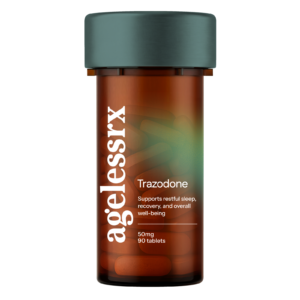
Trazodone is sometimes known as an antidepressant, a medication that works on brain chemistry to improve mood, but at much lower doses it acts on sleep through an entirely different pathway. By blocking key serotonin, histamine, and adrenergic receptors, it reduces neuronal arousal and supports sleep onset. It does this without the dependency concerns associated with traditional sedatives. At sleep-support doses, it may also support slow-wave sleep. This is the deepest stage of rest when the body does much of its tissue repair and growth hormone release.
The Science Behind Tran-Q Sleep
Tran-Q is our proprietary sleep supplement. It combines four well-researched ingredients: passionflower, jujube, California poppy, and English lavender. The formulation takes a multi-pathway approach: rather than relying on a single compound, each ingredient targets a different part of the sleep puzzle, from calming overactive neurotransmitters to promoting deeper, longer-lasting rest.
Here is what the research says about each ingredient:
- Passionflower boosts GABA activity, the brain’s primary inhibitory neurotransmitter. This helps quiet excitement signals and may create a calming, natural sedative effect that supports sleep onset
- Jujube may amplify sleep-promoting neurotransmitter activity, which may help you fall asleep faster and sustain deeper sleep
- California poppy may add to the calming effects of the blend, supporting stress relief and relaxation for more restful sleep
- English lavender is well-studied for its anxiety-reducing effects, which may make it easier to fall and stay asleep
|
Trazodone |
Tran-Q Sleep | |
|---|---|---|
|
Type |
Prescription medication |
Natural supplement |
|
Mechanism |
Blocks serotonin, histamine, and adrenergic receptors to reduce neuronal arousal |
Targets GABA activity, neurotransmitter signaling, and anxiety pathways through botanical ingredients |
|
Key ingredients |
Trazodone HCl (low dose) |
Passionflower, jujube, California poppy, English lavender |
|
Best for |
Those who need more direct sleep onset support under clinician guidance |
Those who prefer a supplement-based approach to calming and rest |
|
Dependency risk |
Low. No dependency concerns have been reported at sleep-dose levels, though individual responses may vary |
Low. No habit-forming compounds. Individual responses may vary and a clinician conversation is recommended before use. |
What Participants Did During the Trial
Participants completed standardized wellness questionnaires at the start of treatment and at set check-ins over approximately three months. The primary outcome was measured using the PSQI (Pittsburgh Sleep Quality Index), a validated tool for assessing sleep quality, alongside the REST-Q, a supplementary scale covering sleep and recovery patterns.
Secondary outcomes included improvements in cognitive function or quality of life. Cognitive function was measured using Creyos online cognitive tests, while quality of life was assessed using the SF-36, a widely used general health survey, and the ISQ (Immune Status Questionnaire), which measures immune health. Alongside these endpoints, the study also collected patient-reported data on mood and activity. Some participants also chose to share wearable-tracked activity data or complete a blood biomarker panel used to estimate biological age. This optional data supports the broader picture but sits outside the defined primary and secondary endpoints. Our Research Team used this full range of inputs as an early, exploratory look at whether improvements in sleep quality connect to changes in cognitive function, quality of life, immune health, and overall well-being.
Observational Sleep for Longevity Trial
Our Research Team launched this Observational Sleep for Longevity Trial to explore whether improvements in sleep quality and quantity may relate to healthy longevity. The trial has now concluded, and early, exploratory analysis is underway. The data collected aimed to examine how healthy sleep may connect to biological aging, immune function, cognitive health, and quality of life.
The trial measured outcomes across three levels, as defined by our Stanford PhD-led Research Team:
- Primary: change from baseline in sleep quality, measured by the PSQI (Pittsburgh Sleep Quality Index) and the REST-Q sleep and recovery scale
- Secondary: change from baseline in quality of life, measured by the SF-36, in immune health, measured by the ISQ (Immune Status Questionnaire), and cognitive function measured via Creyos cognitive tests
- Optional supporting data: wearable-tracked activity levels and a blood biomarker panel for biological age estimation, adding context outside the defined endpoints
Sleep, Longevity, and Real-World Research
Good sleep supports nearly every system tied to how the body ages. Enrollment and data collection for the Observational Sleep for Longevity Trial is complete and analysis is underway. If you want to take your first step toward better sleep, browse our current sleep support options.
Note: The above statements have not been evaluated by the Food and Drug Administration. This product is not intended to diagnose, treat, cure, or prevent any disease.