
Low Dose Naltrexone for Healthspan: What Our Real-World Study Found

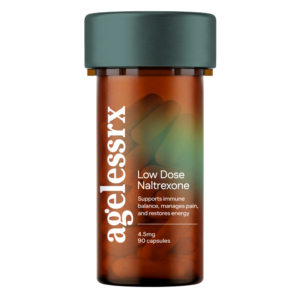
If you read about inflammaging and wonder what you can actually do with that information, this one’s for you. Low Dose Naltrexone has become a growing point of interest in longevity circles. Our published observational study is one of the more rigorous real-world data points available on how it performs outside a clinical trial.
Key takeaways:
- Inflammaging, the chronic low-grade inflammation tied to aging, is one of the most actionable healthspan targets you can tackle
- In a real-world observational study of 5,500 participants, a majority reported improvements in pain, fatigue, inflammation, and mood after at least 4 weeks on Low Dose Naltrexone (LDN)
- LDN is a prescription medication; suitability depends on your individual health history and goals
- Our in-house Research Team conducted the study using longitudinal, real-world data collected from participants seeking LDN treatment via our telehealth platform
What Is Inflammaging and Why Does It Matter?
Inflammaging is the low-grade, chronic inflammation that builds up quietly as we get older. Unlike the acute inflammation your body triggers in response to an infection or injury, this kind never fully goes away. It persists for years. Over time, that ongoing immune activity wears down tissues and organs in ways that speed up biological aging.
Researchers now recognize inflammaging as a shared driver behind many conditions connected to aging. These include cardiovascular disease, cognitive decline, metabolic dysfunction, and frailty. Chronic inflammation is a hallmark of aging, showing how central it is to age-related decline. The immune system becomes less precise with age. It produces pro-inflammatory signals even without a clear threat. That ongoing low-level response appears to speed up cellular damage faster than the body can repair it.
That’s why tracking inflammation has become a focal point in longevity research. Reducing inflammaging is not about shutting down immune function. It’s about recalibrating a system that has drifted out of balance. For anyone interested in extending healthspan years (not merely staying alive longer) inflammaging is one of the most actionable targets available.
How Low Dose Naltrexone Works as an Anti-Inflammatory
Low Dose Naltrexone works through a mechanism that sets it apart from most anti-inflammatory approaches. At standard doses (50 mg), Naltrexone blocks opioid receptors continuously. At the much lower doses used in longevity protocols (1.5 mg to 4.5 mg), something different happens. The brief receptor blockade triggers a rebound effect, prompting the body to upregulate its own endogenous opioid production.
That rebound has downstream effects on immune regulation. Research suggests Low Dose Naltrexone modulates microglial activity (the brain’s resident immune cells), reducing neuroinflammatory signaling. It also appears to influence LDN’s effects on cytokine production more broadly.
About This Study: Design and Population
Our real-world study on Low Dose Naltrexone was a retrospective, observational study of two large, normative aging cohorts recruited through our telemedicine platform. Using structured, longitudinal self-reported data from participants actively using LDN, the study set out to evaluate its effectiveness for improving multiple healthspan metrics. The study population spanned a wide age range. Participants in the primary cohort (80.6% female) were between 19 and 96 years old, with an average age of 54, and more than 85% were over 40.
The primary cohort used the SF-36 Quality of Life (QoL) survey and Immune Status Questionnaire (ISQ) to track 665 participants on Low Dose Naltrexone for at least 3 months. The secondary health check-in cohort drew from a broader pool of 12,134 participants prescribed LDN, which was similarly majority female (74.8% female, 25.1% male); of these, 5,500 completed a check-in at ≥4 weeks of use and 1,450 participants at ≥10 weeks. This gave our Research Team a continuous signal instead of a single snapshot, an approach similar to what we applied in the PEARL Trial. This observational design captures what clinical trials often miss: how a treatment performs in real daily life, across diverse individuals, over extended periods.
A few clarifications worth making upfront:
- This is observational data, not a randomized controlled trial, so it reflects real-world experience and not controlled experimental conditions
- Self-reported outcomes carry inherent subjectivity; our Research Team accounted for this when interpreting results
- The goal was to understand patterns of experienced benefit, not to confirm causation
- Only 19% of the 3,500 participants in the primary cohort who completed a baseline assessment came back for the follow-up used in this analysis (665 participants). A drop-off like this may skew results toward people who felt LDN was working and were more motivated to finish the survey. The secondary cohort shows a comparable pattern.
What the Data Showed
The primary SF-36 dataset tracked 665 participants on Low Dose Naltrexone for at least 3 months, while a secondary patient-reported health assessment captured a cohort of 5,500 participants at ≥4 weeks of use. Low Dose Naltrexone users reported meaningful improvements across several key areas. Here is a snapshot of what the data revealed:
|
Outcome Domain |
Finding |
Dataset |
|---|---|---|
|
Overall quality of life |
~69% of participants (n=460) showed improvement in overall SF-36 score; among these responders, average improvement was ~30%. Across the full 665-person cohort, average improvement was 14.7%. |
Primary (665 participants, 3+ months) |
|
Energy & fatigue |
57% average improvement |
Primary |
|
Physical role limitations |
63% average improvement, the largest gain of any single domain |
Primary |
|
Emotional role limitations |
39% average improvement |
Primary |
|
Pain |
28% average improvement (primary); 69% reported improvement at ≥4 weeks (secondary); 75% reported improvement at ≥10 weeks (secondary) |
Primary & Secondary |
|
Immune functioning |
16.7% average improvement (primary) and 24.6% average improvement among responders |
Primary |
|
Mood |
65% reported improvements at ≥4 weeks; 70% reported improvements at ≥10 weeks |
Secondary |
|
Inflammation |
66% reported improvements at ≥4 weeks; 70% reported improvements at ≥10 weeks |
Secondary |
|
Medication discontinuation |
23.8% of participants were able to discontinue other medications |
Primary (N=665, ≥3 months) |
|
Procedure avoidance |
10.5% avoided planned clinical procedures, including surgeries |
Primary |
The Case for Low Dose Naltrexone as a Gerotherapeutic
A gerotherapeutic is any intervention that targets the biological processes of aging itself, not just its downstream symptoms. The data from our real-world study support that framing: participants reported meaningful improvements in immune function, inflammation, and quality of life. These are the kinds of outcomes researchers look for when evaluating whether a compound belongs in this category. That doesn’t make Low Dose Naltrexone a proven anti-aging therapy, but it does give researchers a clearer signal worth following.
Who May Consider Low Dose Naltrexone for Healthspan
LDN may be worth considering for those who approach health proactively. The participants in our real-world study were largely health-conscious adults who were already tracking their wellbeing and looking for ways to extend their healthiest years.
A few groups often show up in this conversation:
- People noticing early signs of immune dysregulation or chronic low-grade inflammation who want to get ahead of it before it worsens
- Longevity-focused individuals already using Metformin, Rapamycin, and NAD+ who are weighing whether LDN fits alongside their other approaches
- Those who have tried lifestyle interventions and want to look into whether a pharmacological option (such as microdosing GLP-1 and LDN) could offer additional support
That said, Low Dose Naltrexone is a prescription medication. Whether it’s appropriate depends on an individual’s health history, current medications, and goals, and should be discussed with a licensed medical provider. Our approach is to pair the research context with personalized, clinician-guided evaluation, so that any decision about adding LDN to a longevity protocol is grounded in both the science and your specific clinical picture.
The Study of Low Dose Naltrexone in Real-World Practice
Our longevity platform sits at an unusual intersection: a large, real-world patient population and internal Research Team with the methodology to learn from it systematically. Instead of waiting for traditional randomized controlled trials to catch up, our team built this study around longitudinal data already being collected through our telehealth platform. Those efforts also informed our LDN proposal to the National Aging Institute and connect to a broader research portfolio that includes Rapamycin bioavailability research for longevity.
Observational research has real limitations, but it also captures something controlled trials rarely can: how people actually use these protocols in daily life, at real doses, over real time.
Low Dose Naltrexone’s immune-modulating profile makes it a genuinely interesting candidate for tackling inflammaging at a population level. If you’re curious about where it fits in your protocol, that conversation starts with a clinician who understands both the science and your individual health picture.
Note: The above statements have not been evaluated by the Food and Drug Administration. This product is not intended to diagnose, treat, cure, or prevent any disease.