
Why NPR Asked Our Medical Director About Tadalafil for Longevity

You probably know Tadalafil by another name: Cialis. For more than two decades, it’s been best known as a treatment for erectile dysfunction.
Now researchers are asking a different question: could Tadalafil make a difference in our longevity?
Tadalafil helps blood vessels relax and improves blood flow throughout the body. That mechanism has sparked research into areas well beyond sexual health, including cardiovascular health, brain health, inflammation, and vascular aging.
The interest has grown enough to reach the mainstream. When NPR recently explored the emerging research around Tadalafil and longevity, they turned to AgelessRx Medical Director Dr. Jenell Decker for her expertise.
The science is still evolving, but there’s enough here to warrant a closer look. So, what does the research actually say about Tadalafil for longevity?
Key Takeaways
- Tadalafil blocks an enzyme called PDE5, helping blood vessels relax and improving blood flow throughout the body. That whole-body effect is a big reason longevity researchers are paying attention
- Daily low-dose Tadalafil is the approach being studied for potential benefits beyond sexual health, separate from the higher doses typically taken as needed for erectile dysfunction
- Early research is looking into Tadalafil for cardiovascular health, brain health, and vascular aging, although these potential longevity benefits are still being studied
- AgelessRx prescribes daily low-dose Tadalafil to eligible men and women under clinician supervision
Why NPR Asked Our Medical Director About Tadalafil for Longevity
Tadalafil has been around for more than two decades. So why is NPR talking about it now?
When NPR looked into the growing interest in Tadalafil for longevity, they reached out to AgelessRx Medical Director Dr. Jenell Decker for her expertise. She’s been following this research for years, particularly as scientists have started looking beyond what Tadalafil is best known for.
Tadalafil is FDA-approved for erectile dysfunction and benign prostatic hyperplasia, but its effects don’t stop at sexual health. Researchers are studying whether Tadalafil’s effects on circulation and vascular health could have implications for cardiovascular health, cognitive health, and longevity.
That doesn’t mean Tadalafil is suddenly a proven “longevity intervention.” But there are interesting signals worth paying attention to, particularly around daily low-dose Tadalafil. Here’s what we know so far.
What Is Tadalafil and How Does It Work Beyond ED?
Tadalafil is the generic form of Cialis, FDA-approved for erectile dysfunction and benign prostatic hyperplasia. It belongs to a class of medications called PDE5 inhibitors, which help blood vessels relax and improve blood flow.
So, How Does It Work?
PDE5 is an enzyme that breaks down cGMP, a molecule that tells the smooth muscle in your blood vessel walls to relax. Tadalafil blocks PDE5, allowing cGMP to stick around longer and blood vessels to stay more relaxed.
And PDE5 isn’t only found in reproductive tissue. It’s present throughout the body, including the cardiovascular system, lungs, brain, and kidneys. Healthy blood vessels can relax and respond to changes in blood flow. However, as we age, they can become stiffer and less responsive, making it harder for blood to circulate as efficiently. cGMP is one of the signals that helps blood vessels relax and maintain that flexibility.
Research suggests that cGMP signaling declines with age, which may contribute to changes in cardiovascular function and vascular health. By slowing the breakdown of cGMP, Tadalafil may help support that signaling. Whether that translates into meaningful longevity benefits in healthy adults is still an open question, and one researchers are actively looking into.
What Does the Research on Tadalafil for Longevity Show?
So, what happens when a medication known for improving blood flow starts showing effects throughout the rest of the body?
That’s what researchers are trying to understand. The research on Tadalafil in the world of longevity spans cardiovascular health, brain health, and vascular aging. However, much of it comes back to the same idea: blood flow matters far beyond sexual health.
What Does the Research Say About Tadalafil and Cardiovascular Health?
The heart and blood vessels are an obvious place to start. Circulation is the system Tadalafil directly influences.
A 2024 study found associations between Tadalafil use and lower cardiovascular risk, including improvements in endothelial function and heart mechanics with daily dosing. Because the study focused on men, more research is needed to understand whether these findings extend to women. What is clear is that PDE5 biology is similar across men and women, making the need for further research in women both urgent and compelling.
What Could Tadalafil Mean for Vascular Aging?
As we age, blood vessels can become stiffer and less responsive, and chronic low-grade inflammation may contribute to that process. Researchers are interested in whether PDE5 inhibitors like Tadalafil could influence some of the pathways involved.
One area of interest is cGMP, the same molecule involved in Tadalafil’s effects on blood flow. By preventing the breakdown of cGMP, Tadalafil may help support vascular function while also influencing inflammatory pathways associated with vascular aging. A recent review explored these potential anti-inflammatory effects of PDE5 inhibitors, while other research has examined Tadalafil in connection with heart disease risk and cardiovascular health.
We still don’t know whether these effects translate into slower vascular aging in healthy adults. The mechanisms are encouraging, but more research is needed to understand what they could mean for long-term health.
Why Does Longevity Research Focus on Daily Low-Dose Tadalafil?
Not all Tadalafil dosing works the same way, especially in longevity research. For erectile dysfunction, Tadalafil is often taken as needed at doses of 10 to 20 mg.
Daily low-dose Tadalafil, typically 2.5 to 5 mg, provides more consistent exposure to the medication over time. Rather than taking a higher dose when needed, the goal of daily dosing is to maintain steadier Tadalafil levels and more consistent PDE5 inhibition. It’s this sustained effect that researchers are interested in when studying Tadalafil beyond erectile dysfunction.
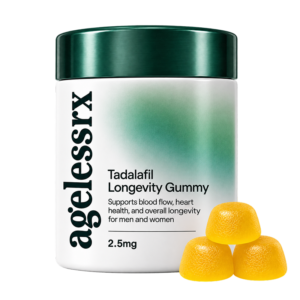
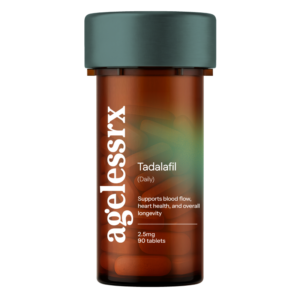
AgelessRx offers daily low-dose Tadalafil in two formats: a Tadalafil oral tablet and the Tadalafil Longevity Gummy.
Meet the First-Ever Tadalafil Longevity Gummy
The Tadalafil Longevity Gummy is the first Tadalafil gummy designed with longevity as its focus, looking beyond sexual health to the broader research around daily, low-dose Tadalafil. Each once-daily chewable delivers 2.5 mg of Tadalafil alongside 600 IU of Vitamin D3 for everyday nutritional support.
The thinking behind the formula is simple: two ingredients with distinct roles in supporting healthy aging. Tadalafil works through PDE5 inhibition to support healthy blood flow and circulation, while Vitamin D3 supports bone health, immune function, and cardiovascular health. Two different mechanisms, easily accessible within one simple daily habit.
|
As-Needed Tadalafil |
Daily Low-Dose Tadalafil | |
|---|---|---|
|
Typical dose |
10-20 mg |
2.5-5 mg |
|
Dosing pattern |
Taken before anticipated activity |
Once daily, ongoing |
|
Primary approved use |
Erectile dysfunction |
Erectile dysfunction, benign prostatic hyperplasia |
|
Effect on cGMP |
Acute, time-limited spike |
Steady-state elevation maintained over time |
|
Target tissue focus |
Reproductive tissue blood flow |
Systemic vascular tissue, cardiovascular system, brain, kidneys |
|
What longevity research studies |
Not the format under study |
Cardiovascular outcomes, brain health, vascular aging |
Who Should Consider Daily Low-Dose Tadalafil?
Tadalafil for longevity is a conversation worth having regardless of sex. Dr. Decker has followed this research for years and frames her view clearly:
“It’s a treatment I believe every man and woman past child-bearing age should consider looking into as a part of their longevity strategy.”
For men, much of the research on daily low-dose Tadalafil has focused on vascular aging, cardiovascular health, and cognitive health, looking beyond sexual function to understand what consistent use may mean throughout the body over time.
Research in women is smaller but growing. One placebo-controlled study of 96 women found improvements in overactive bladder symptoms with daily Tadalafil, while cardiovascular and metabolic research has included both sexes.
Research on Tadalafil and longevity is still evolving, but early signals are promising. AgelessRx offers daily low-dose Tadalafil as a traditional tablet or as the Tadalafil Longevity Gummy, a once-daily chewable with 2.5 mg Tadalafil and 600 IU Vitamin D3. Both require a clinician consultation. Explore your options and see whether daily Tadalafil fits your longevity plan.
Note: The above statements have not been assessed by the Food and Drug Administration. This product is not intended to diagnose, treat, cure, or prevent any disease.