
What The AgelessRx Rapamycin Study Revealed About Bioavailability

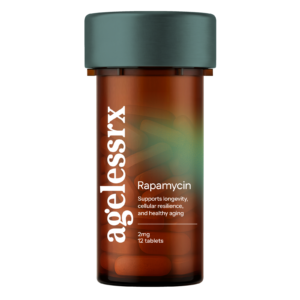
When people talk about Rapamycin for longevity, the conversation almost always starts with one question: how much should you take? Fewer people ask whether that dose is actually getting absorbed. Our study included two cohorts: a 67-participant trial cohort and a 316-participant real-world observational cohort. It found that fat intake at dosing, gut biology, and enzyme activity can shift how much Rapamycin reaches your bloodstream by a wide margin. Here’s what that means for anyone trying to use it well.
Key takeaways:
- Rapamycin absorption varies between people on the same dose
- Taking Rapamycin with a fatty meal may raise absorption by roughly 35% (think a handful of nuts, avocado, or full-fat yogurt)
- Blood levels peak around day 2 after dosing, so blood draw timing matters for accurate monitoring
- Consistent dosing conditions predict reliable blood levels more than brand vs. compounded status
- Through PEARL, our completed real-world study, our Research Team looked at how Rapamycin performs across different doses and individual biology.
Why Bioavailability Matters for Rapamycin Longevity Dosing
Here is a concept worth understanding before anything else: bioavailability. It is simply the share of a dose that actually reaches your bloodstream, regardless of how it is taken. A skin cream has bioavailability. So does a subcutaneous injection. For oral medications like Rapamycin, the key hurdle is what happens after you swallow the pill. It travels through the gut, and then your liver breaks down a portion of it before it ever reaches your cells. That process is called first-pass metabolism. What survives it is what does the work.
For most supplements, a little variability in absorption is not a big deal. However, Rapamycin is different. It works by inhibiting mTORC1, a cellular pathway that controls autophagy and several processes tied to biological aging. Those processes only get activated when enough Rapamycin actually reaches your bloodstream. At the low weekly amounts used for longevity, the gap between a dose that is working and one that is falling short can be meaningful, and it is not always obvious from the outside. That is exactly why understanding bioavailability is the starting point for any serious longevity protocol.
Study Design
Our Rapamycin study was built around a straightforward but underexplored question: what do Rapamycin blood levels actually look like in healthy adults using it for longevity?
The study ran in two parts. The first was a 67-person group (24 female, 43 male) who agreed to blood testing for Sirolimus, the generic name for Rapamycin, following a set dosing and testing schedule. Participants received either commercial (generic) oral Rapamycin tablets or compounded Rapamycin. The second was a larger group of 316 people (87 female, 229 male) drawn from the AgelessRx Observational Research Database. These participants had agreed to share anonymized data about their longevity medicine use, including blood Sirolimus levels, for research purposes.
All participants were healthy, active AgelessRx customers aged 40 or older, without a history of uncontrolled disease, who were receiving Rapamycin for its potential longevity and health improvement benefits. This real-world eligibility profile is part of what makes the findings so relevant: these are not narrowly filtered clinical trial participants. They are people much like you.
Compounded vs. Commercial Rapamycin
Here is the short version: compounded and commercial Rapamycin are not milligram-for-milligram equals, and knowing that changes how you think about your dose.
Our Applied Science Team found that compounded Rapamycin delivers roughly 31% of the absorption per milligram that commercial (generic) Rapamycin does. Put another way, commercial Rapamycin is about 3.48 times more potent per mg. That does not mean compounded Rapamycin does not work. Both formulations reached measurable, therapeutic blood concentrations in our study, and both showed a clear, linear relationship between dose and blood level. The practical implication is that therapeutic blood levels are reachable with compounded Rapamycin, but the dose needs to account for that per-mg difference. If you are on a compounded formulation and your protocol has never been calibrated to your actual blood levels, that gap is worth paying attention to.
What Drives the Difference?
A few practical factors influence how much Rapamycin your body absorbs from any given dose:
- What you eat with it matters. Taking Rapamycin with a fatty meal can raise absorption by roughly 35%. Food with some fat content helps it move through the gut wall more readily. Keeping your meal conditions consistent week to week produces more predictable blood levels.
- Compounded pills are not all made the same way. The inactive ingredients used to bind and fill a capsule (called excipients) vary by pharmacy. Those differences can affect how quickly the pill breaks down and how much Rapamycin gets absorbed. Sourcing from a pharmacy with verified potency testing reduces that uncertainty.
- Formulation type carries different quality standards. Generic and compounded Rapamycin are subject to different regulatory oversight than brand-name Sirolimus. Working with an accredited, independently verified pharmacy is one of the more reliable ways to keep blood levels consistent over time.
The bottom line: your formulation source matters less than how consistently you dose and how carefully your pharmacy verifies potency. Two people on the same formulation but different eating habits can end up at very different blood levels. That consistency piece is where most people have the most room to improve.
Blood Levels Peak at 2 Days
Until our study, the longevity field had no reliable timing benchmark for when to draw blood after a weekly Rapamycin dose. Transplant-era pharmacokinetic data came from daily dosing schedules. That makes those reference points essentially irrelevant for weekly longevity protocols.
Our 316-participant observational cohort found peak concentrations occur approximately 2 days after dosing. Levels then decline gradually through the rest of the week. A blood draw on day 6 will look much lower than one taken on day 2 at the same dose. For practical monitoring, drawing near day 2 captures peak levels. Consistent trough draws on day 6 or 7 offer an alternative reference point. Either approach can work, but consistency is the key. Without standardized measurement windows, blood level comparisons across clinical trials remain hard to interpret.
Inter-Individual Variability
One striking finding from our study on Rapamycin bioavailability was how much Rapamycin absorption varied from person to person, even at the same dose. Across both cohorts, some people reached peak blood levels several times higher than others on the same protocol. That gap has real implications for both safety and effectiveness in longevity use.
Several factors appear to drive this variability:
- Gut microbiome composition can change how well Rapamycin is absorbed through intestinal tissue. Some bacterial profiles actively break down the drug before it reaches the bloodstream.
- Fat intake at the time of dosing affects how quickly and how much Rapamycin gets absorbed. Rapamycin is fat-soluble, meaning it moves through the gut wall more easily in the presence of dietary fat.
Our study found no meaningful association between blood Rapamycin levels and age, sex, or BMI. Those factors do not appear to predict how much Rapamycin reaches the bloodstream, which means variability is driven by biological and metabolic factors that standard demographics cannot capture.
In practice, this variability means two people on the same weekly Rapamycin protocol may be at very different exposure levels. One person may be under-dosed while another is at levels linked to greater immunosuppressive risk. Monitoring blood levels, instead of relying on dose alone, may give a more accurate picture of where any given individual actually stands.
What Drives Variability in Rapamycin Absorption
Key Factors That Influence Absorption
|
Factor |
How it affects absorption |
Practical implication |
|---|---|---|
|
Fat intake at dosing |
High-fat meals can increase absorption by up to 35% |
Dose with a consistent meal type each week for reliable blood levels |
|
Gut microbiome |
Certain bacterial profiles metabolize Rapamycin before it reaches systemic circulation |
Individual gut biology creates baseline variability that diet alone cannot explain |
|
CYP3A4 enzyme activity |
Higher activity increases first-pass metabolism, reducing the fraction reaching the bloodstream |
Genetically variable; two people on identical doses may achieve very different blood levels |
|
P-glycoprotein activity |
Limits drug transport across the gut wall, reducing systemic absorption |
Also genetically variable; compounds the effect of CYP3A4 differences |
|
Body composition & GI transit |
Age-related changes in gut motility and body composition can shift absorption speed and extent |
May contribute to why blood levels rise gradually over the first 6 months of use |
|
Concurrent medications |
Our study found no meaningful association between blood Rapamycin levels and concurrent medications, including Metformin, LDN, Acarbose, and NAD+ |
Medication combinations should still be reviewed with a clinician, but these specific longevity medications do not appear to drive absorption differences based on study data |
Because these variables stack, two people taking the same dose under similar conditions can end up with very different blood levels. This is part of why therapeutic medication monitoring has become a point of interest in longevity-focused Rapamycin use. It is also why our Stanford PhD-led Research Team chose absorption as a central focus of this study.
Why Blood Level Monitoring Should Be Standard Practice
Dose alone tells you little about what the body is doing with Rapamycin. A number on a prescription label cannot confirm whether enough of the drug is actually reaching your bloodstream to slow the mTOR pathway the way it is intended to.
There is also a timing factor worth knowing. Blood Rapamycin levels tend to rise gradually over the first several months of consistent use. They stabilize around the six-month mark. Early monitoring helps catch needed adjustments before patterns set in.
Our Research Team recommends working with a clinician to order periodic blood level testing. Assuming a protocol is working without data is not recommended.
Our Real-World Longevity Evidence
Generating real-world longevity evidence requires a different kind of study design. The PEARL trial was a completed observational research program, built to capture what actually happens when people use low-dose Rapamycin in everyday clinical practice, not in tightly controlled lab settings with strict entry requirements. PEARL enrolled participants across varied doses, schedules, and individual biology, giving our Stanford PhD-led Research Team a dataset that lab studies cannot replicate. The PEARL trial results reflect that ambition: a longevity platform that treats every customer encounter as an opportunity to advance the science of aging and go beyond filling a prescription.
The science keeps pointing to the same conclusion: two people on the same Rapamycin protocol can be at very different exposure levels. Consistent dosing conditions and blood level monitoring close that gap. Your protocol gets a lot more useful when you know where you actually stand.
Note: The above statements have not been evaluated by the Food and Drug Administration. This product is not intended to diagnose, treat, cure, or prevent any disease.