
Can Women Take Tadalafil? The Evidence Gap Explained


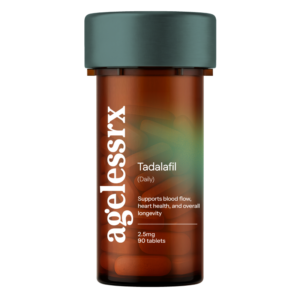
Women make up roughly half the population. So why does the science so often tell only half the story? Clinical research has a long history of treating male biology as the default, and Tadalafil is a good example of where that leaves women: working from an evidence base that was never designed with them in mind.
We can’t go back and rewrite decades of research. What we can do is be clear about what the science tells us, where the gaps remain, and use the best evidence available to give women the context they deserve. When it comes to Tadalafil, that means reframing it from solely an ED medication for men to a longevity therapy for men and women alike.
Key takeaways:
- Women can take Tadalafil. Tadalafil is FDA-approved for pulmonary arterial hypertension in both men and women, so its use in women already has clinical precedent
- Much of the large-scale research into Tadalafil’s cardiovascular and longevity-related potential comes from male cohorts, which means we know considerably less about these effects in women
- There is women-specific clinical research. In a placebo-controlled trial of 96 women, daily 5 mg Tadalafil improved overactive bladder symptoms over 12 weeks
- Hormones may be an important piece of the puzzle. Estrogen status may influence whether certain potential Tadalafil benefits translate to perimenopausal and postmenopausal women
How Does Tadalafil Work?
Tadalafil is a PDE5 inhibitor, meaning it blocks the phosphodiesterase type 5 (PDE5) enzyme that breaks down cyclic guanosine monophosphate (cGMP). Think of cGMP as a “relax” signal for blood vessels. By slowing its breakdown, Tadalafil allows that signal to stick around longer, helping smooth muscles relax and blood vessels widen.
That increase in blood flow is what made Tadalafil famous as an erectile dysfunction treatment. But PDE5 isn’t exclusive to male anatomy, and neither is Tadalafil’s mechanism.
PDE5 is found in smooth muscle tissue throughout the body, including the lungs, bladder, immune and brain tissue. That helps explain why the conversation around Tadalafil for Longevity extends beyond its original use for erectile dysfunction. Wherever PDE5 is active, Tadalafil may have an effect, although what that effect means clinically depends on the tissue and, importantly, the evidence behind it.
Can Women Take Tadalafil? What the FDA Approval Tells Us
One piece of context that may surprise you is that Tadalafil is actually not new to women’s health. Tadalafil is FDA-approved to treat pulmonary arterial hypertension (PAH) in both men and women.
PAH is a serious condition in which the small arteries in the lungs narrow, making it harder for blood to flow through them and forcing the right side of the heart to work harder. By blocking PDE5 in pulmonary vascular smooth muscle, Tadalafil helps those vessels relax and widen, lowering the resistance the heart has to pump against.
Why does that matter here? Because it gives us an important distinction: women taking Tadalafil isn’t the experimental part of this conversation. Tadalafil already has an FDA-approved indication that includes women. The evidence gap appears when we ask a different question: What do we know about Tadalafil’s potential long-term benefits for cardiovascular, metabolic, or longevity-related effects in women in particular?
Why Are Women Underrepresented in Tadalafil Research?
Most large-scale Tadalafil research, including studies into heart disease risk reduction, Alzheimer’s risk, and all-cause mortality, has been conducted mainly in men. The studies included male populations, researchers largely built dosing protocols around male participants, and the long-term outcome data largely reflects male biology. So when women ask whether those same findings apply to them, science doesn’t yet have an equally complete answer.
This mirrors a much broader problem in clinical research. For decades, researchers underrepresented or excluded women from many cardiovascular and pharmacological trials, in part because they worried that hormonal fluctuations could complicate study results. A lack of evidence in women is not the same thing as evidence that something doesn’t work in women. Sometimes, it simply means the question wasn’t adequately studied.
Researchers and clinicians still have important questions to answer: Does PDE5 biology differ enough between men and women to produce meaningfully different outcomes? Does hormonal status matter? Should dosing thresholds differ? And could the longevity-related signals observed in men translate to women?
For now, these remain open questions. Transparently, the science isn’t saying “no.” In many cases, it’s still saying “the biology is promising, but we don’t know yet.”
Can Tadalafil Improve Sexual Function in Women?
There’s a biological reason researchers have studied Tadalafil for female sexual dysfunction. PDE5 is present in clitoral and vaginal smooth muscle, giving Tadalafil a plausible pathway for influencing the physical side of sexual arousal. By increasing cGMP activity in genital tissue, Tadalafil may promote vasodilation and increased blood flow.
But improving blood flow is not the same as improving sexual function.
Research suggests PDE5 inhibitors can produce physiological changes in genital blood flow. The harder question is whether those changes translate into meaningful improvements in desire, arousal, satisfaction, or the overall sexual experience. A single switch doesn’t control female sexual function. Desire, arousal, and satisfaction can involve blood flow, central nervous system signaling, hormones, psychological factors, relationship context, and more. Tadalafil primarily acts on the blood-flow piece of the complicated equation.
More blood flow, then, doesn’t automatically mean better sexual function. Some women may benefit, while others may notice little change. Right now, the research isn’t strong enough to tell us who is most likely to respond.
Can Tadalafil Help Women with Overactive Bladder?
Overactive bladder affects about 22% of women, yet it rarely gets the treatment attention it deserves. In a trial of 96 women with idiopathic overactive bladder, daily 5 mg Tadalafil improved urinary frequency, urgency, and incontinence episodes compared with placebo over 12 weeks. Reported adverse effects were mild to moderate.
The bladder’s detrusor muscle contains PDE5. This smooth muscle drives the involuntary contractions that create that sudden “I need to go now” feeling. When Tadalafil increases cGMP activity in this tissue, the muscle can relax, potentially reducing those contractions and the urgency that comes with them.
Tadalafil’s potential for women extends beyond sexual function. Research like this gives us women-specific clinical data in an entirely different area of health, and another reason to study what Tadalafil may be doing beyond its best-known uses.
Does Estrogen Affect How Tadalafil Works in Women?
Estrogen does much more than govern reproductive cycles. It interacts with cardiovascular signaling throughout the body, and researchers have found that it may also influence how female tissue responds to PDE5 inhibition. That matters when we think about Tadalafil in perimenopausal and postmenopausal women, when estrogen levels are changing or declining.
Research published in the Journal of Clinical Investigation offers an important clue. In a preclinical model, Tadalafil’s protective effects on female cardiac tissue depended on estrogen. After researchers removed ovarian hormones, Tadalafil no longer produced the same antiremodeling effects. When they restored estrogen, those effects returned.
In other words, Tadalafil was still there. The pathway was still there. But the hormonal environment changed the response.
That doesn’t tell us that Tadalafil will or won’t provide a particular benefit to a perimenopausal or postmenopausal woman. It tells us there may be another variable to consider. As researchers continue investigating Tadalafil in women, hormonal status deserves some spotlight, particularly given the broader women’s healthspan gaps that have left questions like these unanswered for too long.
Potential Benefits Being Investigated in Women
Several distinct areas of Tadalafil research in women are worth understanding, though the evidence base for most remains early or incomplete.
|
Benefit Area |
What the Research Shows |
Evidence Status |
|---|---|---|
|
Pulmonary blood pressure |
Tadalafil is FDA-approved for pulmonary arterial hypertension in women, helping blood vessels relax and reducing strain on the right side of the heart. |
Best supported: FDA-approved indication |
|
Bladder control (OAB) |
Daily low-dose Tadalafil may reduce urgency and frequency in women with overactive bladder by relaxing bladder muscle contractions. |
Women-specific RCT data available |
|
Genital arousal and lubrication |
Increased blood flow to vaginal and clitoral tissue may improve physical arousal response and lubrication in women with genital arousal disorder. Whether that translates to subjective satisfaction is less certain. |
Early and mixed: physiological changes documented, functional benefit unclear |
|
Cardiovascular protection |
Longevity-focused data was drawn almost entirely from male cohorts. Dedicated, long-term women-specific studies are needed before these findings can be extended to female populations. |
Theoretical for women: male-cohort data only |
What Are the Side Effects & Drug Interactions of Tadalafil for Women?
Tadalafil’s side effects in women are generally expected to look similar to those seen in men because the underlying mechanism is the same. Common side effects include headache, facial flushing, indigestion, back pain, muscle aches, and nasal congestion. These effects can vary with dose and are often temporary.
The biggest safety concern is one that applies to both women and men: nitrates. Combining Tadalafil with nitrates, including nitroglycerin, can cause a dangerous drop in blood pressure. The two should not be taken together.
Other health conditions can also change whether Tadalafil is appropriate. A clinician should review any history of cardiovascular events, blood pressure concerns, or serious liver or kidney disease before you start Tadalafil. This is where individual medical history matters more than sex alone. Tadalafil is a prescription medication, so a licensed clinician should review your health history, current medications, and potential risks before treatment.
How Does Tadalafil Compare to Other Treatments for Women?
Understanding where Tadalafil fits means understanding what problem it actually solves. Different treatments for women’s sexual and urological health work on entirely separate biological systems.
|
Approach |
Primary Target |
Mechanism |
|---|---|---|
|
Tadalafil |
Blood vessels/vasculature |
PDE5 inhibition increases blood flow to genital and bladder tissue |
|
Hormone therapy (bHRT) |
Endocrine system |
Restores estrogen/progesterone levels affecting tissue health and libido |
| PT-141 Injection (Bremelanotide) |
Central nervous system |
Activates melanocortin receptors in the hypothalamus to drive dopamine-mediated desire |
|
Anticholinergics (OAB) |
Nerve signaling |
Block muscarinic receptors to reduce involuntary bladder contractions |
The important thing to understand is that these treatments aren’t interchangeable; they act on different parts of the biology. A woman with overactive bladder may have several treatment options. However, her symptoms, health history, and the mechanism being targeted will determine the right approach.
The same is true for sexual health. Tadalafil primarily works through blood flow, while desire involves signaling in the brain that Tadalafil wasn’t designed to target. PT-141, for example, works through central pathways involved in sexual desire instead of directly increasing genital blood flow. Women’s Hormone Care covers another part of the picture by reviewing hormonal changes that can affect sexual function and other symptoms.
For some women, there may be more than one factor at play. That’s why the goal isn’t simply choosing between Tadalafil, PT-141, or hormonal support. A clinician can look at symptoms, medical history, medications, cardiovascular health, and hormonal status to determine which approach, or potentially a stack, makes sense for the individual.
Tadalafil for Women at AgelessRx
We prescribe Tadalafil for Longevity to eligible men and women, with each prescription guided by a US-licensed clinician who reviews your health history, current medications, cardiovascular health, and relevant hormonal context before treatment begins.
We can’t rewrite decades of research that left women underrepresented, but we can be transparent about what we know today and what we still don’t. Our Stanford PhD-led in-house Research Team reviews the available evidence before treatments are offered , including newer longevity tools for women. If you’re considering Tadalafil, the AgelessRx clinical intake helps put that evidence into the context of your own health history.
Note: The above statements have not been reviewed by the Food and Drug Administration. This product is not intended to diagnose, treat, cure, or prevent any disease.