
Why You Shouldn’t Worry About High Vitamin B12 Levels

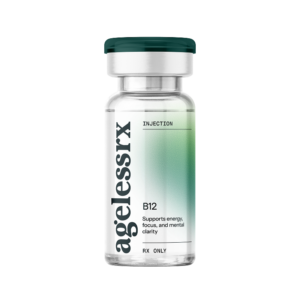
High vitamin B12 levels on a blood test can catch people off guard, particularly when they’re supplementing regularly. For those taking B12 injections or high-dose oral supplements, elevated serum B12 is a common and expected outcome.
This post explains why B12 levels rise with supplementation, what those numbers actually mean, and when a high reading warrants further investigation.
Key takeaways:
- High B12 on your labs while supplementing signals successful absorption, not a health problem
- B12 is water-soluble, so your kidneys filter and excrete any excess naturally, with no toxicity risk
- Lab reference ranges were built from non-supplementing populations, so your numbers will look different by design
- High B12 without supplementation warrants a clinician follow-up to rule out liver, blood, or kidney conditions
- Long-term Metformin use can deplete B12 by blocking gut absorption; injectable B12 bypasses that pathway entirely
Why Do Blood Levels of B12 Rise with Supplementation?
Vitamin B12 supplementation, whether through injections or high-dose oral forms, can lead to increased serum B12 levels. This is a common response and doesn’t necessarily indicate any health issues.
When taking B12 via injections or high doses of supplements, it bypasses the absorption limits of dietary B12, leading to a temporary rise in blood B12 levels. These higher levels reflect successful absorption and distribution of the vitamin into the bloodstream, where tissues can take it up.
What Is Considered a High B12 Level?
Standard laboratory reference ranges for serum B12 typically fall between 200 and 900 picograms per milliliter (pg/mL). A result above 900-1,000 pg/mL is generally flagged as high, though some labs use slightly different thresholds. When taking B12 supplements or injections, readings can climb well above this range and still be considered clinically unremarkable in healthy individuals.
It is worth noting that researchers developed lab reference ranges largely from non-supplementing populations. Someone actively taking B12 should expect their numbers to look different from baseline, and that context matters when reading results.
Is High B12 Dangerous?
Research consistently supports the safety of vitamin B12, even at high levels, because B12 is water-soluble. The body naturally excretes any excess through urine, which helps keep its levels in balance efficiently.
Both the National Institutes of Health (NIH) and the Institute of Medicine have not set an upper limit for B12 intake, even when doses exceed the daily recommended amounts by thousands of micrograms.
As a result, high serum B12 levels in individuals supplementing with B12 are typically harmless and do not cause adverse health effects.
Does High B12 Cause Any Symptoms?
In people who are supplementing, high serum B12 rarely causes noticeable symptoms. Because B12 is water-soluble, the kidneys filter and excrete excess amounts through urine, so the body manages its own levels naturally without toxic accumulation.
In cases where very high B12 levels occur without supplementation, some individuals report acne-like breakouts, mild skin flushing, or digestive changes. An underlying condition driving the elevation more commonly causes these issues, rather than B12 itself. If you experience unexpected symptoms alongside a high B12 reading, bringing that to your clinician’s attention is a sensible step.
Understanding When High B12 Requires Investigation
In individuals who are not supplementing, high B12 levels can sometimes point to underlying health issues. Liver conditions such as hepatitis or cirrhosis may cause B12 to leak from liver cells into the bloodstream, producing artificially raised readings. Certain blood disorders, including polycythemia vera and chronic myelogenous leukemia, are also associated with high B12. Kidney disease and some solid tumors have been linked to unexplained B12 elevation in people who are not actively supplementing.
However, for those supplementing, high B12 levels are generally a reflection of recent supplementation, not a cause for concern. If deficiency or tissue utilization concerns arise, functional markers like methylmalonic acid (MMA) and homocysteine levels may offer additional context.
|
High B12 with supplementation |
High B12 without supplementation | |
|---|---|---|
|
Likely cause |
B12 injections or high-dose oral supplements saturating the bloodstream |
Liver disease, blood disorders, kidney disease, or certain tumors |
|
What it means |
Successful absorption; vitamin is available for the body to use |
Possible underlying condition releasing stored B12 into the blood |
|
Symptoms to watch |
Rarely any; mild skin flushing or digestive changes can occur in some cases |
Symptoms tied to the underlying condition (fatigue, jaundice, etc.) |
|
Recommended action |
No changes needed if feeling well; discuss with your clinician if concerned |
Follow up with your clinician to rule out underlying health issues |
Medical Consensus: High Serum B12 in Supplements is Safe
The medical community broadly agrees that high serum B12 levels resulting from supplementation are safe for individuals with no underlying health issues. Leading medical sources, including The BMJ and Harvard’s Nutrition Source, make clear that high B12 levels alone do not indicate toxicity or adverse effects. They are typically a sign of successful supplementation and are well within the body’s tolerance range.
Signs You May Need More B12
B12 deficiency doesn’t always show up immediately, but common indicators include persistent fatigue, brain fog, numbness or tingling in the hands or feet, difficulty with memory or concentration, and mood changes. Some people also notice pale or yellowish skin, or a sore, inflamed tongue.
Certain groups face a higher risk of low B12: adults over 50, people following a vegan or vegetarian diet, those with gastrointestinal conditions affecting absorption, and anyone on medications known to reduce B12 uptake. A simple blood test can confirm whether your levels are within a healthy range and guide a decision about supplementation.
How Metformin Affects B12 Levels
Long-term Metformin use is associated with reduced B12 absorption. Metformin appears to interfere with a calcium-dependent mechanism in the small intestine needed to absorb B12 from food. For people on long-term Metformin therapy, routine B12 monitoring is often recommended, and supplementation may be appropriate depending on individual levels.
Injectable B12 is particularly relevant here because it bypasses the gut absorption pathway that Metformin disrupts, delivering the nutrient directly into the bloodstream. If you are taking Metformin and have questions about your B12 status, reviewing your levels with your clinician is a practical next step.
Note: The above statements have not been evaluated by the Food and Drug Administration. This product is not intended to diagnose, treat, cure, or prevent any disease.