
B12/MIC: Explained

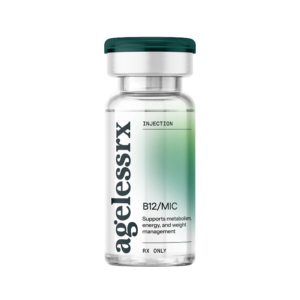
Editor’s note: This article was written by AgelessRx Co-Founder, Dr. Sajad Zalzala based on his experience and expertise.
Whether you’ve recently started using B12/MIC, or are considering it to support your weight loss journey, I’m happy to offer my expertise and share what you need to know to better determine where it best fits within your health and wellness journey.
Key takeaways:
- B12/MIC combines B12 with Methionine, Inositol, and Choline to support metabolism, energy, and modest weight loss
- Injectable B12 bypasses the gut, making it more readily absorbed than oral supplements
- Methionine’s link to mTOR stimulation is based on small, limited studies not yet applicable to human longevity
- You can use B12/MIC short-term (up to 6 months) or long-term (up to 12 months) depending on your goals
What Is B12?
Let’s first start with B12, in and of itself. Vitamin B12 (cobalamin) plays a key role in red blood cell formation, cell metabolism, and nerve function. It also drives the production of DNA, the molecules inside cells that carry genetic information.
The body of evidence in support of these claims is substantial. But perhaps the best proof of B12’s superpowers is what happens when it is not adequately present in the body. Individuals with known B12 deficiencies, or those prone to a potential deficiency due to their lifestyle, must supplement vitamin B12. Failure to do so may lead to a variety of health issues, including anemia, fatigue, muscle weakness, intestinal problems, nerve damage, and mood disturbances.
Vitamin B-12 deficiency is not super common in the U.S.; however, plant-based diets are. Roughly 6% of Americans now identify as vegetarian and about 4% follow a vegan diet. Unfortunately, the parameters of plant-based diets restrict individuals from the very foods where B12 is naturally occurring, mainly fish, poultry, meat, eggs, and dairy products.
Deficiencies are also common in older adults and people with digestive tract conditions or pernicious anemia that affect the absorption of nutrients. These individuals can receive an injectable form of the vitamin, which altogether bypasses the gastrointestinal tract. B12 injections are generally considered more readily absorbed in the body and do not have to be administered as often as oral tablets. As a result, injectable B12 has become a popular choice for anyone seeking B12 supplementation, well beyond those with digestive health concerns.
What Is B12/MIC?
At AgelessRx, we have taken the supplemental B12 injection and optimized it with methionine, inositol, and choline (hence the acronym “MIC”). The full formula and the roles of its various components are as follows:
- B12 is a water-soluble vitamin central to metabolism, helping the body use fat & carbohydrates for energy & to make new protein
- Methionine is an amino acid that may speed up fat removal within the liver and neutralizes toxins
- Inositol is a carbocyclic sugar that plays a critical role in metabolic function, cell signaling, and fat breakdown in the liver
- Choline is a key nutrient that helps to regulate memory, mood, muscle control & many other functions
This combination is most effective when used as part of a healthy lifestyle, including a balanced diet and regular exercise. B12/MIC may support energy levels, build lean muscle, and even initiate modest weight loss. For some, it can help jump-start progress.
Patients looking to help push beyond a sticking point in their health goals may best use B12/MIC as a short-term tool. For others looking for a long-term solution, B12/MIC can be a regular tool in their arsenal of weight management strategies.
Should I Be Concerned with Methionine?
Methionine may support initial weight loss and long-term weight management. Methionine may also increase stimulation of the mammalian target of Rapamycin (mTOR). The anti-aging community generally views mTOR inhibition as a viable longevity treatment.
If inhibiting mTOR supports longevity, mTOR stimulation may shorten lifespan. So why would we use Methionine (thought to activate mTOR) in our B12/MIC formulation?
The short answer: research doesn’t yet support this theory enough to say definitively this is or is not the case.
What Does the Research Say?
Much of this consensus about Methionine is based on a few small studies. The results of a 2005 study, for instance, showed that eliminating Methionine in the diets of mice extended life. These findings are somewhat misleading and not directly applicable to human longevity. After all, completely eliminating Methionine from a human diet would be nearly impossible (methionine food sources).
There is a very short study on Methionine restriction involving a small sample size of human patients. In this case, patients were fed highly processed and prepared meals that would be extremely difficult to replicate and maintain in daily life outside of the study.
What Is AgelessRx’s Stance?
While this research raises valid questions, our in-house Research Team believes more work is needed in this area. Our team does NOT believe the amount of methionine in our B12/MIC formula is enough to activate mTOR in any clinically meaningful way. Our expert pharmacists agree. With that in mind, we believe the benefits of methionine for weight management outweigh the potential impact on longevity when used in these amounts.
Like Methionine, obesity and insulin resistance are thought to be strong activators of mTOR. If we can use safe amounts of methionine to control these factors, we cancel out any potential effect methionine itself would have on mTOR. In fact, B12/MIC may be a versatile mTOR inhibitor. That’s because its various components each work to combat distinct triggers of mTOR stimulation.
If you are concerned about methionine, AgelessRx recommends a short-term B12/MIC protocol. This means weekly B12/MIC injections for up to 6 months (or 6 total refills). Once you reach the 6-month mark, or 6 total refills, take a break from B12/MIC for at least 3 months. This break is called a “washout” period. After the washout, you can resume B12/MIC and repeat the same protocol.
How Long Should I Take B12/MIC?
B12/MIC can be a short-term or long-term tool in your longevity toolkit. Talk to your AgelessRx clinician about your health goals for B12/MIC. Together, you can build a plan that’s right for you. If your clinician approves a B12/MIC prescription, it’s up to you how long you stay on it.
|
Short-Term |
Long-Term | |
|---|---|---|
|
Duration |
Up to 6 months (6 refills) |
Up to 12 months |
|
Best for |
Breaking a plateau or jump-starting weight loss; also recommended if you have concerns about Methionine |
Ongoing weight management and metabolic support |
|
Frequency |
Weekly injections |
Weekly injections |
|
Flexibility |
Pause or cancel before next refill |
Pause or cancel before next refill |
If you stick with B12/MIC long term, you can stay on it for up to 12 months. At that point, you’ll need to complete an Annual Medical Check-In. Our team will review whether B12/MIC is still a good fit for you.
AgelessRx makes it easy to manage your prescription. You can pause or cancel at any time before your next refill, via your portal or by contacting our team.
B12/MIC works best as part of a healthy lifestyle. That includes a balanced diet and regular exercise. Based on our expert opinion, B12/MIC is fine to use short-term or long-term, depending on your health goals. Talk to a healthcare professional to find out which is right for you.
How B12/MIC Fits into Modern Weight Management
Injectable weight management tools have become a major part of mainstream health conversations in 2025 and 2026. GLP-1 receptor agonists like semaglutide and tirzepatide have drawn enormous attention for their weight loss results. With that attention has come a broader openness to the role of injectable therapies in supporting metabolic goals.
B12/MIC fits naturally within this context. For those using GLP-1 medications, B12/MIC can serve as a complementary support tool. It may help maintain energy levels and support lean muscle during caloric restriction. For those not on a GLP-1, it remains a well-rounded, accessible option for anyone looking to support metabolism and energy through a healthy lifestyle.
The injectable wellness category continues to grow. B12/MIC stands out for its well-characterized ingredient profile and flexibility as both a short-term and long-term tool. Talk to your AgelessRx clinician about your full health picture. They can help determine how B12/MIC fits best within your overall wellness plan.
A February 2026 study in Clinical Obesity reviewed over 480,000 adults on GLP-1 therapy. It found that B vitamin deficiency is a documented nutritional risk of long-term GLP-1 use. Researchers concluded that nutritional deficiencies should be treated as a common consideration in GLP-1 therapy. For GLP-1 users, injectable B12/MIC bypasses the gastrointestinal tract. This may make it a practical way to keep B12 levels supported without relying solely on diet or oral supplements.
Note: The above statements have not been evaluated by the Food and Drug Administration. This product is not intended to diagnose, treat, cure, or prevent any disease.